
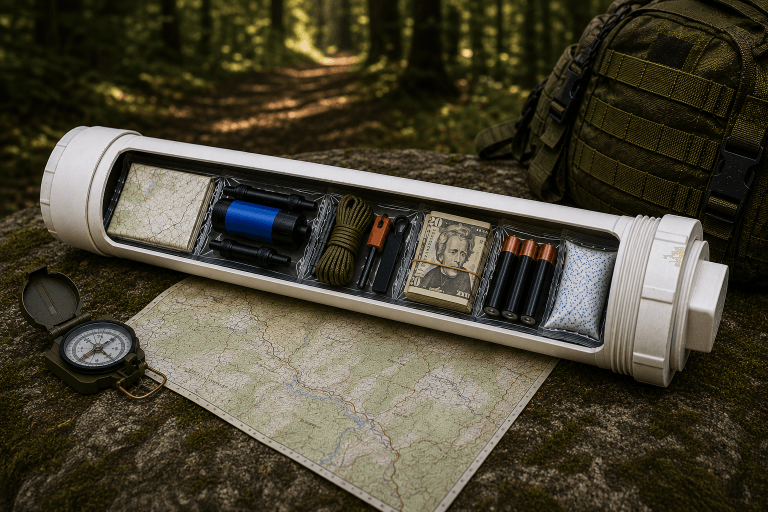
The idea of storing supplies for future use is far older than the modern preparedness movement. Throughout history, people have hidden food, tools, weapons, valuables, and emergency provisions to protect them from theft, preserve them for difficult times, support travel, or prepare for conflict. While the containers and equipment have changed, the principle remains the same: if your primary resources become unavailable, having supplies already positioned elsewhere can make all the difference.
A survival cache is simply a pre-positioned collection of equipment and supplies stored for a specific purpose. It may support a long walk home after a vehicle breakdown, provide emergency equipment along a frequently traveled route, sustain you for several days during an evacuation, or simply serve as insurance against the unexpected. There is no single “correct” way to build one because every cache should reflect the needs, resources, environment, and goals of the person who built it.
Perhaps the biggest misconception about survival caches is that they exist solely for extreme disasters. In reality, a well-planned cache can prove valuable during far more common situations, including severe weather, extended power outages, wildfires, flooding, road closures, vehicle failures, or unexpected travel disruptions. Good preparedness is rarely about preparing for one catastrophic event; it’s about building practical layers of redundancy that help you adapt when life doesn’t go according to plan.
This guide explores the principles behind designing, building, maintaining, and using survival caches effectively. Rather than providing a one-size-fits-all checklist, the goal is to help you understand the tradeoffs involved so you can build caches that make sense for your own circumstances.
What Is a Survival Cache?
At its core, a survival cache is nothing more than a supply point positioned in advance of needing it. Whether hidden inside a waterproof container, secured in a trusted building, or stored in a vehicle, every cache exists to solve a specific problem before that problem occurs.
The mission of the cache determines everything that follows. A small cache intended to support a walk home after work will look very different from one designed to provide three days of sustainment at a remote property. Likewise, a cache containing replacement medical supplies serves an entirely different purpose than one focused on emergency communications or defensive equipment.
The mistake many beginners make is thinking of a cache as a collection of “survival gear.” Experienced planners typically approach the problem in reverse. They first identify the mission the cache is expected to accomplish, then select only the equipment necessary to support that mission. This keeps caches practical, affordable, and easier to maintain over time.
Just as important is understanding what a survival cache is not.
A cache should not contain equipment that you rely on every day or items that would create a major hardship if lost. Your primary defensive firearm, your everyday medical kit, or your only quality flashlight generally belong on your person or readily accessible at home—not buried somewhere in the ground. A cache should contain equipment that provides meaningful capability if recovered, but can also be abandoned without compromising your overall preparedness.
Think of a cache as a backup plan rather than your primary plan. If circumstances require you to recover it, it should make your situation better. If circumstances prevent you from reaching it—or if it disappears entirely—your preparedness strategy should still remain intact.
That philosophy serves as the foundation for every successful survival cache, regardless of its size, location, or intended purpose.
The Cache Philosophy: Mission Drives Contents
One of the easiest mistakes to make when building a survival cache is asking, “What should I put in it?” before asking, “What is this cache supposed to accomplish?”
Every survival cache should have a clearly defined mission. That mission determines its location, container, contents, maintenance schedule, and even whether the cache should exist at all. Without a purpose, it’s easy to spend money filling a container with equipment that may never be useful together.
A cache designed to support a two-hour walk home after a vehicle breakdown has very different requirements than one intended to sustain a family for several days following a natural disaster. Likewise, a medical cache should prioritize treatment capability, while a communications cache may focus on radios, batteries, maps, and reference materials. There is no universal packing list because there is no universal mission.
The same principle applies to size. Bigger is not automatically better. A compact cache containing only the equipment necessary to accomplish its intended purpose is often more practical than a large container filled with unnecessary gear. Smaller caches are generally easier to conceal, less expensive to build, simpler to maintain, and quicker to recover when time matters.
It’s also worth recognizing that survival caches are not intended to replace your everyday equipment. Instead, they provide redundancy when your primary gear is unavailable, damaged, lost, inaccessible, or simply insufficient for the situation. If recovering a cache dramatically improves your capabilities, it has done its job. If losing that cache would significantly weaken your overall preparedness, you may have stored the wrong equipment inside it.
Think of each cache as one layer within a larger preparedness strategy. Your home supplies, vehicle equipment, everyday carry gear, bug-out bag, and survival caches should complement one another rather than duplicate one another completely. Some overlap is expected, but each should fill a different role.
Before purchasing a container or selecting a hiding place, take a few minutes to answer several basic questions:
- What problem is this cache intended to solve?
- Under what circumstances would I retrieve it?
- Who is expected to use it?
- How long should it sustain that person?
- What capabilities should it provide?
- Could I abandon it without creating a larger problem?
Answering those questions first often simplifies every decision that follows.
Types of Survival Caches
Not every survival cache serves the same purpose. Some are designed to support routine travel, while others exist only for rare emergencies. Some may fit inside a small waterproof container, while others occupy several large storage boxes. Understanding the strengths and limitations of each type helps ensure your caches are built around realistic needs rather than assumptions.
Get-Home Cache
A get-home cache supports one of the most common preparedness scenarios: reaching home after becoming unexpectedly stranded. It may be positioned along a regular commuting route, stored at a trusted location between frequently traveled destinations, or placed where transportation disruptions are most likely to occur.
These caches typically focus on practical necessities such as weather-appropriate clothing, water filtration, food, first aid supplies, navigation tools, communications equipment, lighting, and basic repair items. Their purpose is not long-term survival but simply helping bridge the gap between where you are and where you need to be.
Defensive or Fighting Cache
While often discussed within preparedness circles, a defensive cache represents only one possible type of survival cache and should be built with careful consideration of applicable laws and individual circumstances.
Rather than replacing equipment you already rely upon, a defensive cache typically serves as a source of backup capability should primary equipment become unavailable. Depending on the builder’s needs, it might contain magazines, ammunition, cleaning supplies, spare optics, replacement parts, or other support equipment. Some builders may also choose to include firearms where legally permissible, recognizing the additional maintenance, corrosion prevention, security, and legal considerations that accompany their storage.
The objective is redundancy—not storing irreplaceable equipment.
Sustainment Cache
A sustainment cache is intended to support a person or family for an extended period, often ranging from twenty-four to seventy-two hours or longer depending on its mission. Because these caches generally contain more equipment, they often require larger containers and more deliberate placement.
Typical contents may include food, water treatment capability, shelter equipment, clothing, cooking supplies, medical items, hygiene products, tools, and other resources needed to remain functional until reaching a safer or better-supplied location.
Medical Cache
Medical supplies deserve special consideration because many items have expiration dates, temperature limitations, or packaging requirements. A dedicated medical cache allows these supplies to be organized separately while making routine inspections and rotation much easier.
Depending on its intended purpose, a medical cache may range from a compact trauma kit to a more comprehensive collection capable of supporting multiple people over several days.
Water and Filtration Cache
Water presents a unique challenge. While storing water is certainly possible, it also increases weight, bulk, and long-term maintenance requirements. For many situations, storing the ability to safely collect and purify water offers greater flexibility than attempting to cache large quantities of water itself.
A compact filtration system, purification tablets, collapsible containers, or metal containers suitable for boiling water often provide more capability per cubic inch than several gallons of stored water.
Learn more thru the posts behind, Water Security: The Foundation of Preparedness
Urban Cache
Urban caches solve a different problem than those placed in remote environments. Space is limited, concealment opportunities differ, and the likelihood of accidental discovery is often much higher.
Rather than relying on burial, urban caches frequently emphasize blending into their surroundings through ordinary-looking containers and carefully selected locations. Simplicity, discretion, and accessibility generally become more important than storing large quantities of equipment.
Destination Cache
A destination cache is positioned where you ultimately intend to arrive rather than somewhere along the journey. A family member’s property, hunting land, seasonal cabin, or other trusted location can all serve as suitable destinations, allowing supplies to be stored where they are most likely to be needed once travel is complete.
Regardless of which type of cache you choose to build, remember that the mission—not the container or the equipment—should always drive the design. A small cache that perfectly supports its intended purpose is far more valuable than a large cache filled with items that never work together toward a common goal.
Choosing Containers
The container is often the first thing people think about when planning a survival cache, but it should actually be one of the last decisions made. Once you understand the mission of the cache, the size of the equipment it must hold, and the environment where it will be stored, the appropriate container usually becomes obvious.
No single container is ideal for every application. Each offers advantages and disadvantages in terms of durability, weather resistance, concealment, cost, and accessibility. Selecting the right one is simply a matter of balancing those tradeoffs against the intended mission.
Ammo Cans
Military-style steel ammo cans have been used for decades because they are durable, widely available, and provide an excellent seal when their rubber gasket remains in good condition. Their rectangular shape also makes them easy to organize and pack efficiently.
However, steel eventually corrodes if moisture finds its way inside or the exterior coating becomes damaged. They also tend to look exactly like what they are—ammo cans—which may attract unwanted attention if discovered. For caches that are frequently accessed or stored above ground, they remain an excellent choice. For long-term buried storage, additional moisture protection is strongly recommended.
Check out our selection of Ammo Cans
All-Weather Dry Boxes
Modern plastic dry boxes, such as those produced by companies like Plano and others, offer an excellent balance between weather resistance, durability, and affordability. They resist rust, weigh less than comparable steel containers, and are available in a wide range of sizes.
These containers work particularly well for vehicle caches, destination caches, garage storage, and locations where the cache may be hidden but not necessarily buried. Like any container, their waterproof performance depends on maintaining clean seals and undamaged latches.
Check out this selection of Dry Cans and Hard-Sided Cases
PVC Pipe Caches
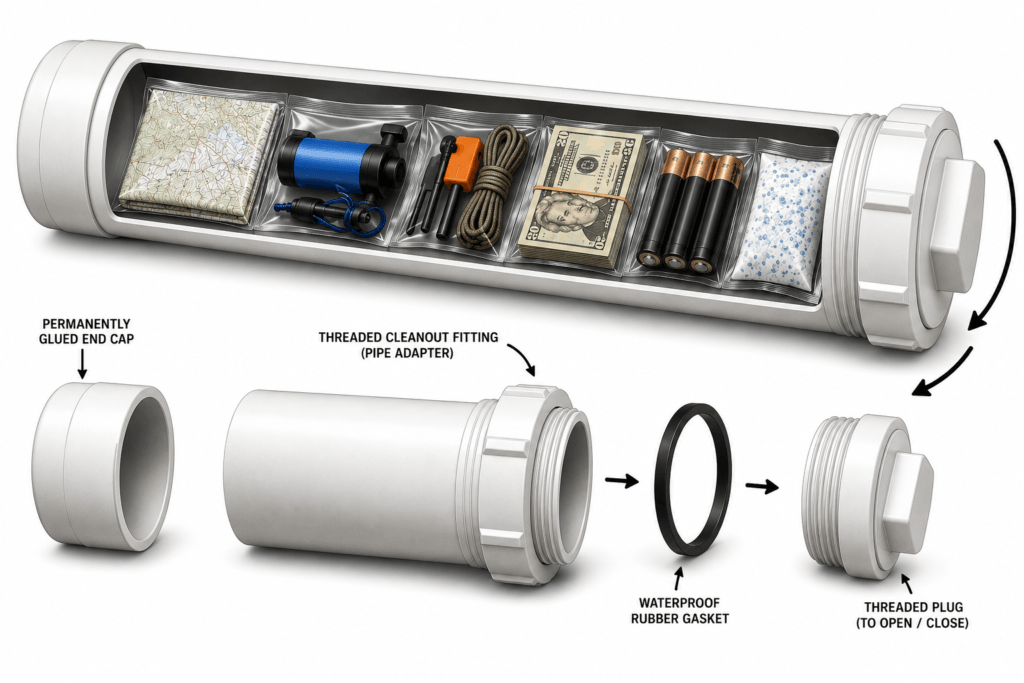
PVC pipe remains one of the most popular choices for compact buried caches. A simple design using PVC pipe, a permanently glued end cap, and a threaded cleanout fitting allows surprisingly effective protection against moisture while keeping costs relatively low.
Because their diameter is limited, PVC caches are best suited for compact equipment such as water filters, survival tools, documents, emergency cash, batteries, maps, fire-starting supplies, or a broken-down firearm component where legally appropriate.
One drawback is often overlooked: after spending years underground, threaded caps can become extremely difficult to remove by hand. Dirt, corrosion on threaded inserts, paint, and environmental conditions can all make opening the container challenging without additional tools. If your cache requires immediate access under stressful conditions, this is worth considering during the planning stage.
Improvised Containers
Not every cache requires specialized equipment. In some environments, an ordinary-looking container may attract far less attention than one that appears purpose-built.
Plastic storage bins, weather-resistant utility boxes, steel containers, or even old trash cans can all serve effectively when matched to the appropriate mission and environment. In areas already cluttered with construction debris, agricultural equipment, or other discarded materials, an unattractive container that blends naturally into its surroundings may actually provide better concealment than an expensive commercial cache system.
The goal is not to make the container interesting—it’s to make it forgettable.
Commercial Cache Systems
Purpose-built survival cache containers are available in a variety of sizes and configurations. Many offer exceptional sealing systems, durable construction, and features specifically designed for long-term storage.
Their primary disadvantage is cost. While they may offer meaningful advantages in certain situations, many preparedness-minded individuals can build highly effective caches using far less expensive solutions. As with every preparedness purchase, reliability should justify additional expense.
Affordability vs. Reliability
It is easy to become convinced that every cache requires expensive equipment. In reality, most successful caches owe their effectiveness to thoughtful planning rather than premium containers.
A modestly priced container that protects its contents and fulfills its mission is often a better investment than an expensive solution that exceeds the actual requirements. Build within your budget, invest where reliability matters, and remember that several well-designed caches often provide more capability than one exceptionally expensive cache.
Packing for Moisture, Heat, and Time
The environment is often a greater threat to a survival cache than theft. Moisture, temperature fluctuations, insects, corrosion, and simple aging work continuously against stored equipment. A cache that remains perfectly hidden but fails when opened has accomplished nothing.
Protecting your equipment begins long before the container is closed. Individual items should be packaged to resist moisture intrusion even if the outer container eventually develops a leak. Vacuum sealing provides one of the most effective methods of reducing both moisture exposure and storage volume, particularly for clothing, medical supplies, and other soft goods.
Read more here on Vacuum Sealing: A Simple Way to Extend Storage
For items that are not vacuum sealed, heavy-duty resealable plastic bags provide another useful layer of protection. Many experienced builders reinforce the zipper closure with a strip of duct tape, helping reduce the chance that the seal works open over time while also providing additional protection against dirt and moisture.
Silica gel desiccant packets provide inexpensive insurance against trapped humidity inside a cache. While they cannot compensate for a leaking container, they can significantly reduce condensation and moisture damage within a properly sealed cache.
Check out Dessicant Packs here
Heat deserves just as much consideration as moisture. Caches stored in vehicles, attics, metal buildings, or shallow ground exposed to direct sunlight may experience temperatures far beyond what many supplies are designed to withstand. Batteries, adhesives, medications, certain plastics, and some food products can all degrade much faster under prolonged heat exposure.
Medical supplies deserve particular attention. While removing bulky commercial packaging may save space, that packaging often provides important protection, lot identification, expiration dates, and usage information. Carefully consider whether space savings justify sacrificing those benefits before repackaging medical equipment.
Batteries introduce another challenge. Even high-quality batteries eventually reach the end of their service life, and leaking batteries can damage nearby equipment beyond repair. Whenever possible, remove batteries from electronics before storage and package them separately. Regular inspection intervals become especially important for caches containing battery-powered equipment.
While moisture and heat are the most common threats to stored electronics, some preparedness-minded individuals also choose to protect critical devices from electromagnetic events by storing them inside Faraday bags before placing them in the cache. Radios, GPS units, backup hard drives, and other sensitive electronics can benefit from this additional layer of protection, particularly in caches intended for long-term storage.
Check out our guide to Faraday Cages and Bags for Prepper Stealth to learn how they work and when they make sense.
Firearms and ammunition introduce their own long-term storage considerations. Lubricants can migrate or dry over time, corrosion can develop if moisture is present, and metal components require periodic inspection just like any other precision equipment. Proper preservation techniques become increasingly important as storage periods grow longer.
Ultimately, no packing method eliminates the need for maintenance. Every cache should be inspected on a schedule appropriate for its contents, allowing expired items to be replaced, batteries rotated, seals checked, and moisture problems corrected before they compromise the equipment inside.
What Actually Belongs in a Cache?
Once the mission has been defined, selecting the contents becomes much easier. Every item should support the purpose of the cache. If it doesn’t contribute to that mission, it probably doesn’t belong there.
Avoid the temptation to build a “do everything” cache. Packing for every possible emergency usually results in carrying extra weight, wasting space, increasing cost, and creating unnecessary maintenance. A cache should be intentional rather than comprehensive.
Instead of thinking about individual products, think in terms of capabilities. Ask yourself what the cache needs to enable, then choose equipment that delivers those capabilities.
Water
Few resources are more important than water, but storing large quantities presents obvious challenges. Water is heavy, occupies valuable space, and requires periodic replacement if stored for extended periods.
For many caches, it makes more sense to store the ability to obtain safe drinking water than to store the water itself. Compact filtration systems, purification tablets, collapsible water containers, and metal containers suitable for boiling water often provide greater flexibility than several gallons of stored water.
Check out Redundant Water Filtration: Why One Method Isn’t Enough
Food
Food should support the intended duration of the cache without creating unnecessary maintenance. Shelf stability, temperature tolerance, nutritional value, preparation requirements, and packaging all deserve consideration.
A cache intended to support a short trip home may only require calorie-dense snack foods, while a sustainment cache may justify freeze-dried meals or other long-term storage options.
Learn more thru the posts behind, Food Security: Building a Resilient Food System for Preparedness
Fire and Shelter
Maintaining body temperature often becomes a higher priority than preparing a hot meal.
Depending on the cache’s mission, simple fire-starting equipment, emergency blankets, tarps, ponchos, cordage, or compact shelter systems may provide tremendous value while occupying very little space.
Redundancy also matters. A disposable lighter, ferrocerium rod, and waterproof matches each have strengths and weaknesses. Including more than one ignition method improves reliability with very little additional weight.
Medical Supplies
Medical equipment should reflect both the expected risks and the builder’s level of training.
A compact first aid kit may be perfectly appropriate for one cache, while another may justify trauma supplies or more comprehensive medical equipment. Regardless of size, inspect medical supplies regularly and replace expired components before they become unreliable.
Learn more thru the posts behind, Medical Preparedness: Building the Capability to Care for Yourself and Others
Navigation and Communications
Finding your destination is difficult if you no longer know where you are.
Paper maps, compasses, waterproof notebooks, pencils, and emergency radios can all prove invaluable when electronic navigation becomes unavailable. Local maps deserve special consideration, particularly for caches positioned away from familiar surroundings.
Electronics introduce their own maintenance requirements, so remember to package batteries separately and inspect them periodically.
Learn more thru the posts behind, Communication & Information: Staying Connected and Informed When Systems Fail
Lighting and Power
A quality flashlight is one of the most useful tools that can be stored in nearly any cache.
Consider how replacement batteries will be stored, whether rechargeable equipment is appropriate for the intended mission, and how environmental conditions may affect long-term battery life.
Rather than selecting the brightest flashlight available, prioritize reliability, simplicity, and common battery types whenever possible.
Check out our selection of flashlights and batteries
Cash and Documents
Financial systems don’t always fail completely to become inconvenient.
Small amounts of cash can be useful during power outages, communication failures, or other situations where electronic payment systems become temporarily unavailable. Some people also choose to include prepaid gift cards, though their long-term usefulness depends on expiration policies and the availability of participating retailers.
Copies of important documents, emergency contact information, or reference materials may also be appropriate depending on the cache’s purpose.
Tools
Simple hand tools often solve problems that expensive equipment cannot.
A multitool, compact repair kit, duct tape, cordage, work gloves, or other basic repair supplies may dramatically increase the usefulness of a cache without occupying much additional space.
Choose tools based on realistic problems you expect to encounter—not hypothetical situations.
Check out our selection of multi-tools
Defensive Equipment
Depending on individual circumstances and applicable laws, some builders may choose to include defensive equipment within certain caches.
This might range from spare magazines and ammunition to cleaning supplies, replacement optics, or, where legally appropriate, firearms. Whatever choices are made, remember the guiding principle established earlier: a cache should enhance your capabilities if recovered, but losing that cache should not significantly reduce your overall preparedness.
Check out our selection of Non-Lethal Defense products
Primary equipment belongs with you or somewhere readily accessible—not hidden where it may never be recovered.
Firearms, Ammunition, and Defensive Gear
The topic of firearms often dominates discussions about survival caches, but in reality they represent only one category of equipment that may or may not belong in a particular cache.
A cache built to support a walk home from work may have little need for defensive equipment beyond what is already carried daily. Conversely, a cache intended to support an extended stay at a remote property may justify additional defensive resources. As with every other decision discussed throughout this guide, the mission determines the contents.
If firearms are included, long-term storage presents several additional challenges. Moisture remains the greatest enemy, making proper packaging and corrosion prevention essential. Protective lubricants, vapor corrosion inhibitors, vacuum sealing, and desiccants all help preserve metal components during extended storage, but none eliminate the need for periodic inspection.
Ammunition generally stores well when protected from moisture and extreme environmental conditions, though long-term exposure to excessive heat can shorten service life and degrade packaging. Magazines should also be inspected periodically for corrosion or physical damage, regardless of whether they are stored loaded or unloaded.
Space efficiency deserves consideration as well. Certain firearms can be partially disassembled for storage without affecting their long-term usability. For example, separating an AR-15 into its upper and lower receivers significantly reduces the amount of space required while allowing it to fit into containers that would otherwise be too small.
Above all, avoid placing irreplaceable equipment into a cache. If recovering that cache is essential to your overall preparedness plan, you’ve likely invested too much into a single location. A survival cache should provide additional capability—not become a single point of failure.
Head over to our:
Gun Care and Cleaning Supplies Department
Cache Placement Strategy
A well-built cache stored in the wrong location may never be useful. Selecting where to place a cache deserves just as much attention as deciding what goes inside it. Accessibility, concealment, legality, environmental conditions, and the intended mission all influence whether a cache ultimately succeeds or fails.
There is no universal placement strategy because every person’s daily routine, property access, travel patterns, and preparedness goals differ. Some people rarely travel beyond their local community, while others spend hours on the road every day. Your cache network should reflect your own life rather than someone else’s.
Hub-and-Spoke Placement
One common approach is a hub-and-spoke model centered around your home or primary location. Smaller caches are positioned in multiple directions from that central point, allowing access regardless of which direction you may be traveling.
This approach works well for people whose work, family, hobbies, or other responsibilities regularly take them throughout the same general area. Individual caches can support different missions without requiring every cache to contain the same equipment.

Linear Placement
Another effective strategy places caches along frequently traveled routes. A commuter, for example, may position caches between home and work, while someone with family several hours away might establish supply points along that route.
Linear placement recognizes a simple reality: if you’re likely to need a cache, you’ll probably be traveling somewhere you already travel.
This approach often reduces the number of caches required while ensuring supplies are positioned where they’re most likely to be useful.

Destination-Based Placement
Sometimes the destination itself is the most logical place for a cache.
A trusted family member’s property, hunting camp, seasonal cabin, workshop, or other secure location may provide an excellent place to store equipment that doesn’t need to travel with you. Since these locations are generally visited periodically, inspection and maintenance become much easier than with completely hidden caches.
Strategic Placement
Regardless of the overall strategy, every individual cache should be placed where it balances accessibility with security.
Ask yourself:
- Can I realistically reach this location when I need it?
- Can I recover it without specialized equipment?
- Is the surrounding area likely to change over time?
- Could flooding, construction, or erosion affect this location?
- Will I still recognize this area years from now?
A cache that cannot be found—or cannot be recovered—is no better than one that never existed.
Basic land navigation skills become valuable here. GPS coordinates are useful, but electronics fail, batteries die, and technology changes. Knowing how to identify terrain features and navigate using a map and compass provides valuable redundancy when recovering caches.
Learn more thru our Mobility & Transportation posts
Burying Caches Without Making Them Impossible to Recover
Burying a cache often sounds straightforward until it’s time to retrieve it.
Many first-time builders focus almost entirely on concealment while giving little thought to recovery. Unfortunately, the conditions that exist when you bury a cache may be completely different from those when you need it.
Hard-packed summer soil, frozen winter ground, heavy rainfall, drought, roots, rocks, and changing terrain can all turn a simple recovery into an exhausting project. A cache buried deeper than necessary may be well concealed, but that extra depth provides little benefit if you cannot reasonably recover it when time and energy are limited.
Check out our selection of packable shovels
Likewise, consider the tools you expect to have available. Digging through compacted soil with a folding knife or multitool is an unpleasant experience. If your recovery plan assumes you’ll have a full-sized shovel, ask yourself whether that’s a realistic assumption under the circumstances in which the cache is intended to be used.
Environmental conditions deserve equal attention. Low-lying areas may flood seasonally, high water tables can introduce persistent moisture, and rocky terrain may prevent digging altogether. Even if the container remains watertight, repeatedly exposing it to standing water rarely improves its long-term reliability.
PVC pipe caches deserve a special mention here. Their compact size makes them excellent candidates for burial, but they’re generally best suited for smaller, high-value items rather than bulky equipment. Documents, emergency cash, fire-starting equipment, compact water filters, maps, batteries, and other space-efficient items fit naturally within their limited diameter.
One practical lesson many experienced builders eventually learn is that threaded PVC caps become increasingly stubborn with time. Dirt, paint, mineral deposits, and years underground can make opening the container surprisingly difficult without tools. Planning for recovery is just as important as planning for concealment.
Ultimately, the best buried cache is one you can recover safely, quickly, and confidently—not necessarily the one that’s buried the deepest.
Urban Caches
Not every survival cache belongs in the woods.
For many people, daily life takes place almost entirely within cities and suburbs, making urban caches every bit as relevant as those hidden in remote areas. The principles remain the same, but the environment changes dramatically.
Urban caches often prioritize concealment through normalcy rather than isolation. A container that looks completely ordinary within its surroundings is frequently less noticeable than one designed to appear highly tactical or purpose-built.
Smaller caches generally perform better in urban environments. Their reduced size makes them easier to conceal, easier to recover, and less costly to lose if circumstances change.
Contents should also reflect the mission. Cash, prepaid gift cards, maps, communications equipment, batteries, medical supplies, water filtration, clothing, or compact repair tools may all prove more valuable than attempting to build a miniature survival camp inside a hidden container.
Urban environments also introduce unique risks. Construction projects, landscaping, property ownership changes, routine maintenance, surveillance cameras, cleanup crews, and increased pedestrian traffic all increase the likelihood that a cache may eventually be discovered or unintentionally disturbed.
For that reason, urban caches often benefit from remaining simple, inexpensive, and easily replaceable. If losing a cache would create a major hardship, it probably contains too much value for the location in which it’s being stored.
OPSEC, Privacy, Security, and Legality
A survival cache only has value if it remains available when you need it. That means thinking beyond the container itself and considering who knows it exists, where it is located, and whether storing it there is appropriate in the first place.
One of the simplest ways to improve the security of a cache is to tell fewer people about it. Every additional person who knows a cache exists increases the possibility that its location may eventually become known to someone else. While trusted family members may need enough information to recover a cache during an emergency, broadening that circle without good reason only increases unnecessary risk.
Read more on The Importance of Trust in Crisis Situations
Documentation deserves similar consideration. Many people record GPS coordinates, maps, or written descriptions of cache locations. These can be valuable tools, but they should be protected appropriately. A notebook left in plain sight or an unsecured digital file may reveal far more information than intended.
Sharing caches with others also requires careful thought. A shared cache can distribute costs, expand available resources, and support multiple people during an emergency. At the same time, it introduces additional questions.
- Who is responsible for maintenance?
- Who replaces expired supplies?
- Who has permission to access it?
- What happens if one person needs it before the others?
- How will everyone know if the cache has already been used?
There are no universal answers, but those conversations are far easier before the cache is built than after it has already been relied upon.
Legal considerations should never be overlooked. Laws governing firearms, ammunition, medications, public lands, and private property vary widely by jurisdiction. A cache should never be placed where doing so violates applicable laws or the property rights of others.
Likewise, avoid placing caches on private property without the owner’s knowledge and permission. Even if your intentions are good, someone else’s land is not an appropriate place to store emergency equipment without their consent.
Public land deserves similar caution. Parks, forests, wildlife management areas, and other public properties often have regulations regarding digging, abandoned property, environmental impacts, or long-term storage. Before placing anything on public land, understand the applicable rules and the potential consequences if the cache is discovered.
Finally, remember that no hiding place is guaranteed to remain hidden forever. Construction projects, erosion, floods, fallen trees, maintenance crews, curious hikers, and simple bad luck can all expose even the best-concealed cache. Build every cache with the assumption that one day it might be found by someone else.
If that possibility would create a serious financial, legal, or personal hardship, reconsider what you’re storing and where you’re storing it.
Maintenance and Rotation
Building a cache is only the beginning. Left alone indefinitely, even the best-designed cache will eventually suffer from aging equipment, expired supplies, dead batteries, deteriorated packaging, or environmental damage.
Routine inspection is what transforms a one-time project into a reliable preparedness resource.
How often a cache should be inspected depends largely on its contents and accessibility. A vehicle cache may be checked several times each year, while a remote destination cache might only be inspected annually. Regardless of the schedule, consistency is more important than frequency.
During each inspection, look for signs of moisture intrusion, damaged seals, corrosion, insects, rodent activity, or physical damage to the container itself. Confirm that vacuum-sealed packaging remains intact, desiccant packets are still serviceable if appropriate, and threaded lids or latches continue to operate properly.
Consumable items deserve particular attention.
- Replace expired food.
- Rotate medical supplies approaching expiration.
- Inspect batteries for leakage or corrosion.
- Refresh water treatment products as recommended by the manufacturer.
- Replace damaged clothing or equipment.
Maps, contact information, and other reference materials should also be reviewed periodically. Roads change, businesses close, phone numbers become outdated, and even familiar landmarks can disappear over time.
Some builders find it helpful to inspect caches on a recurring schedule tied to a memorable date, such as the beginning of spring and fall or during daylight saving time changes. The exact schedule matters less than ensuring inspections actually happen.
Every maintenance visit also provides an opportunity to reassess the cache itself. Your commute may have changed. Equipment preferences evolve. Family circumstances shift. A cache that perfectly matched your needs five years ago may benefit from updates today.
Preparedness is rarely static, and neither should your caches be.
Common Cache Mistakes
Nearly every experienced prepper has looked back at an early cache and found something they would do differently. Fortunately, most mistakes are easy to avoid once you know what to watch for.
Some of the most common include:
- Building a cache before defining its mission.
- Spending more money than the cache’s purpose justifies.
- Packing too much equipment “just in case.”
- Burying a cache deeper than it can realistically be recovered.
- Ignoring moisture control inside the container.
- Forgetting to inspect and rotate supplies.
- Allowing batteries to remain installed in stored electronics.
- Choosing locations prone to flooding, erosion, or future development.
- Storing irreplaceable primary equipment instead of backup resources.
- Assuming GPS alone is sufficient for locating a cache years later.
- Placing caches where doing so may violate laws or property rights.
- Failing to consider how a cache will actually be recovered under stressful conditions.
Good cache design is rarely about clever hiding places or expensive equipment. More often, it’s the result of careful planning, realistic expectations, and disciplined maintenance.
Final Thoughts
A survival cache is ultimately an investment in redundancy. It acknowledges a simple reality: sometimes the equipment you have with you won’t be enough, and sometimes the supplies you expected to reach won’t be available.
That doesn’t mean every preparedness plan requires a dozen hidden containers scattered across the countryside. In fact, many people will benefit more from building one thoughtfully planned cache than several poorly designed ones.
Start with a realistic mission. Build around your actual travel patterns, property, and circumstances. Choose reliable containers, protect your equipment from the environment, inspect it regularly, and remember that every item inside should earn its place.
Most importantly, don’t measure the success of a cache by how much equipment it contains. Measure it by whether it accomplishes the mission it was built to perform.
Preparedness isn’t about owning the most gear. It’s about having the right resources, in the right place, at the right time. A well-designed survival cache is simply another way to make that happen. Like every aspect of preparedness, start small, learn from experience, and improve your caches over time.
Disclaimer: As an Amazon Associate we earn from qualifying purchases. This doesn’t change your price – it helps support the site.