
A knife’s blade shape affects far more than its appearance. The position of the tip, curvature of the cutting edge, and amount of material supporting the point all influence how a knife handles everyday tasks.
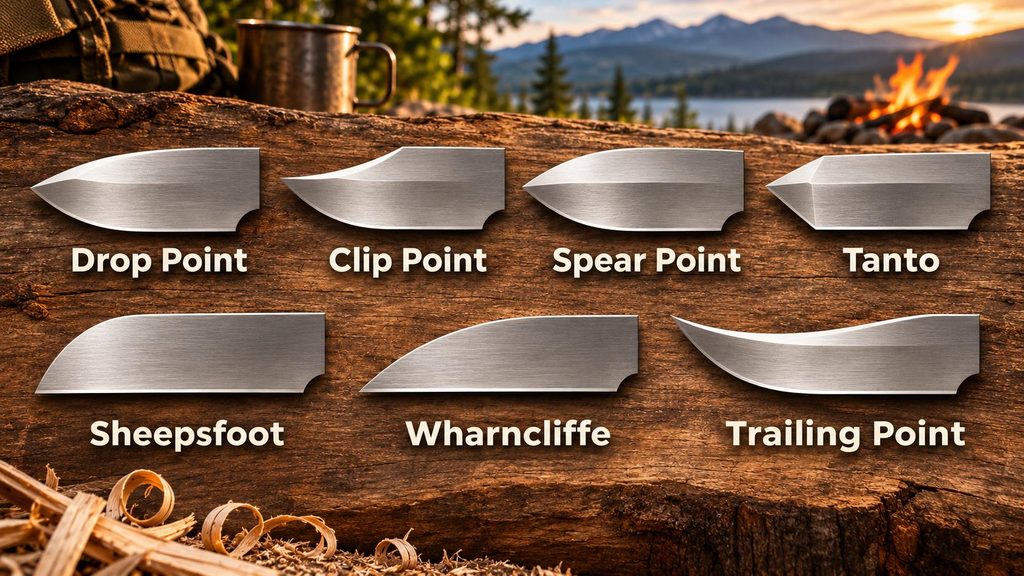
A drop point might be comfortable for general outdoor work, while a Wharncliffe offers precise control when opening packaging or cutting along a straight line. A trailing point provides a sweeping edge useful for skinning game, and a sheepsfoot emphasizes controlled cutting with less risk of accidental punctures.
Understanding these differences can help you choose a knife that suits the work you actually expect it to perform.
This guide examines seven common blade shapes, explains their advantages and limitations, and offers practical guidance for everyday carry, hunting, camping, and general utility.
What Is a Knife Blade Shape?
A knife’s blade shape, also called its profile, describes the outline of the blade when viewed from the side. The shape is defined largely by the spine, cutting edge, and point.
The spine is the generally unsharpened back of a single-edged blade. The cutting edge may be straight, curved, or angular. Where those two lines meet determines the tip’s position and geometry.
One important characteristic is the belly, the curved portion of the cutting edge. A pronounced belly provides a long, sweeping contact area for slicing, while a straighter edge can offer better control for certain push cuts and detail work.
Tip geometry also matters. A fine, narrow point may be useful for detailed cutting or starting a cut in a confined area, but its thin construction can make it vulnerable to damage. A broader point generally retains more supporting material, although actual strength depends on the entire blade.
Blade shape should not be confused with blade grind. The profile describes the knife’s outline, while the grind describes the cross-sectional geometry produced as the blade tapers toward its cutting edge.
A drop-point knife, for example, could feature a full flat, sabre, hollow, or other grind. Two knives with the same outline may cut differently because of blade thickness, grind geometry, edge angle, and steel.
Our companion article, Knife Blade Grinds Explained: Which Is Best for Bushcraft and Survival?, examines those differences in greater detail.
Seven Common Knife Blade Shapes and Their Uses
Drop Point: The Versatile General-Purpose Design
The drop point is one of the most recognizable knife profiles. Its spine slopes gradually downward toward the tip, which typically sits below the blade’s upper edge.
This shape often provides a useful balance of cutting-edge curvature, tip control, and material supporting the point.
Drop-point knives are popular for everyday carry, hunting, camping, and general outdoor work. A moderate belly handles ordinary slicing tasks efficiently, while the lowered point provides control when working near materials you don’t want to puncture accidentally.
For hunters, that characteristic can be especially helpful during field dressing, where controlling the tip matters when working around hide and internal organs.
The design’s principal limitation is that a broader tip may be less suited to extremely fine detail work than a narrow clip point.
For someone purchasing a first general-purpose knife, a well-designed drop point is an excellent place to begin.
Common applications: Everyday cutting, camping, field dressing, food preparation, and general utility.
Clip Point: A Fine Tip for Detailed Work
A clip-point blade has a portion of its spine that appears to have been cut away near the tip. This clipped section may be straight or concave, creating a relatively narrow, acute point.
The clip point is closely associated with traditional pocket knives, hunting knives, and Bowie-style designs.
Its slender tip makes it useful when carefully starting cuts, trimming material, or working in confined areas. Depending on the curvature of the cutting edge, a clip-point knife can also perform everyday slicing tasks quite effectively.
That fine tip comes with a tradeoff.
Because less material may support the extreme point, some clip-point designs are less tolerant of twisting or lateral pressure than broader-tipped alternatives.
A clip point can be an excellent practical knife, particularly for users who value precise tip work, but its point should be treated as a cutting feature rather than a miniature pry bar.
Common applications: Detailed cutting, traditional pocket-knife use, hunting, and general utility.
Spear Point: A Centered, Balanced Profile
A spear-point blade brings the spine and cutting edge toward a point near the blade’s centerline. The two sides of the profile are typically approximately symmetrical around the tip.
This arrangement produces a centered point that can be useful for precise tip placement and certain controlled cutting tasks.
Spear points appear on fixed-blade knives, folding knives, and a variety of specialized designs.
An important distinction is that a spear-point shape does not necessarily mean the blade is sharpened on both sides. Some feature a single cutting edge with an unsharpened spine or decorative false edge. Others are double-edged.
For ordinary utility, the centered tip can be useful, although some spear-point designs offer less sweeping belly than a comparable drop point.
The shape alone also tells you little about strength. A broad spear point and a very narrow, thin one can behave quite differently.
Common applications: Controlled detail work, selected everyday-carry designs, and specialized knives.
Tanto: An Angular Tip With Distinct Cutting Sections
The modern American-style tanto is immediately recognizable by its angular profile.
Instead of a continuously curved cutting edge, many examples feature a relatively straight primary edge that meets a shorter forward edge at a pronounced corner.
This creates two distinct cutting sections and an angular transition near the tip.
Many tanto designs retain considerable material toward the point, which can contribute to a robust tip. That said, overall strength still depends on blade thickness, grind, steel, heat treatment, and construction.
The forward edge can be useful for certain controlled utility cuts, while the primary edge handles general cutting tasks.
The most noticeable disadvantage is the interrupted belly. Someone accustomed to a smoothly curved blade may find an angular tanto less convenient for long, continuous slicing motions, particularly when preparing food or processing game.
Sharpening also requires attention to both cutting sections if the owner wants to preserve the original profile.
Tanto knives have a distinctive appearance, but appearance alone is rarely a compelling reason to choose one over a more conventional utility profile.
Common applications: General utility, controlled cutting, and tasks suited to an angular edge.
Sheepsfoot: Controlled Cutting With a Rounded Tip
The sheepsfoot blade has a generally straight cutting edge and a spine that curves or drops downward into a rounded, relatively blunt tip.
That rounded end is its defining feature.
Traditional sheepsfoot knives were associated with maritime and agricultural work, where controlled cutting was valuable and an aggressive piercing point was less desirable.
Today, the design appears on work knives, rescue-oriented cutting tools, and everyday-carry models.
A straight edge provides predictable contact when making push cuts or slicing against a flat surface. The rounded tip can also reduce the likelihood of accidentally puncturing nearby material or skin compared with a sharply pointed blade.
However, it should never be considered injury-proof. Its sharpened edge remains fully capable of causing serious cuts.
A sheepsfoot is less suitable when the job specifically requires a fine, pointed tip.
For utility work involving packaging, rope, cardboard, and similar materials, its straightforward cutting geometry can be particularly useful.
Common applications: Rope cutting, packaging, controlled utility work, and selected rescue tasks.
Wharncliffe: A Straight Edge With a Precise Point
Wharncliffe blades are sometimes confused with sheepsfoot designs because both typically feature straight cutting edges.
The important difference is the tip.
A traditional Wharncliffe has a spine that slopes or curves downward toward a relatively fine point, while a sheepsfoot generally ends in a more rounded, blunt tip.
This gives the Wharncliffe a useful combination of straight-edge cutting control and pointed-tip precision.
It’s particularly well suited to opening packages, cutting along marked lines, trimming material, and other tasks where controlled edge placement matters.
The straight edge can be convenient to maintain because it lacks the pronounced belly found on many hunting and general-purpose knives.
On the other hand, a Wharncliffe’s fine tip may be vulnerable to damage if subjected to twisting or prying forces. Its limited belly also makes some sweeping slicing tasks less comfortable than they would be with a drop point or trailing point.
For everyday utility, especially detailed cutting, the Wharncliffe deserves more attention than its relatively unusual appearance might suggest.
Common applications: Precision utility work, packaging, scoring, and controlled straight-edge cuts.
Trailing Point: A Sweeping Edge for Slicing
A trailing-point knife features a tip that curves upward, often rising above the blade’s spine line.
The resulting shape creates a pronounced, sweeping belly with a comparatively long curved cutting edge.
This profile is particularly associated with hunting and skinning knives.
A long belly allows the user to make extended slicing motions, which can be helpful when separating hide from an animal or performing other cutting tasks that benefit from a smooth, continuous edge.
Trailing-point knives also appear in food-preparation and specialized outdoor designs.
Their main disadvantage is the elevated tip.
The point may be less convenient to control during certain close-detail tasks, and its position can increase the risk of accidental punctures if the user is careless.
For general-purpose everyday carry, a trailing point may be less versatile than a drop point. For someone whose work involves extensive slicing or game processing, its specialized geometry can be a significant advantage.
Common applications: Skinning, game processing, food preparation, and extended slicing cuts.
Comparing Blade Shapes: Which Design Fits the Job?
The following comparison provides a practical starting point when evaluating knife designs.
| Blade Shape | Defining Feature | Common Strength | Main Tradeoff |
|---|---|---|---|
| Drop Point | Spine slopes gently toward the tip | Versatile cutting and tip control | Less suited to extremely fine point work |
| Clip Point | Clipped spine forms a narrow tip | Detailed cutting and precise tip placement | Fine tip may be vulnerable |
| Spear Point | Tip near the blade’s centerline | Centered point and controlled placement | Utility varies considerably by design |
| Tanto | Angular forward edge and distinct corner | Controlled cuts and potentially robust tip | Interrupted belly and more involved sharpening |
| Sheepsfoot | Straight edge with rounded tip | Controlled cuts with reduced puncture risk | Limited piercing ability |
| Wharncliffe | Straight edge with fine point | Precision cuts and straight-edge utility | Fine tip; limited slicing belly |
| Trailing Point | Upswept tip and long curved belly | Sweeping cuts and skinning | Less convenient point control for some tasks |
scroll left and right for more content
These characteristics are useful tendencies, not guarantees. Blade thickness, grind, edge geometry, materials, and overall construction can significantly change how a particular knife performs.
A poorly designed drop point won’t automatically outperform a well-executed knife with a more specialized profile.
Everyday Carry and General Utility
For most everyday tasks, a drop point is a sensible starting point. Its combination of belly, controlled tip geometry, and broad utility accommodates everything from opening packages to cutting cordage.
A Wharncliffe or sheepsfoot may be more appealing if most of your cutting involves cardboard, packaging, or materials that benefit from a straight edge.
A clip point is worth considering when fine tip work is a regular requirement.
Hunting and Outdoor Recreation
Drop points remain popular for hunting because they offer a useful combination of slicing ability and tip control.
Trailing points are particularly well suited to extended slicing and skinning work, while clip points can be useful for carefully controlled detail tasks.
For camping and general outdoor chores, overall construction and grind deserve as much attention as the outline. A well-designed knife should be comfortable, controllable, and appropriate for the materials you’re cutting.
If your outdoor work includes woodworking, revisit our guide to blade grinds. Grind geometry often has a greater influence on carving performance than the named blade profile.
Choosing With Maintenance in Mind
Blade shape also influences maintenance.
Straight-edged designs such as sheepsfoot and Wharncliffe blades can be relatively straightforward to sharpen using suitable equipment. A pronounced belly requires consistent control through a curved section, while an angular tanto requires attention to preserving its separate edge segments.
The steel, edge damage, sharpening system, and user’s technique still matter considerably.
For a first knife, consider whether you can maintain its edge using tools and methods you’re comfortable learning. Complicated sharpening arrangements can turn an otherwise useful purchase into a frustrating one.
Choosing a Blade Shape Without Overthinking It
Knife manufacturers offer hundreds of variations, including modified drop points, reverse tantos, recurves, and combinations that don’t fit perfectly into traditional categories.
Those variations are worth exploring once you know what features matter to you. For a first purchase, begin with the work the knife will perform most often.
If you want a single everyday utility knife, a drop point is difficult to overlook. If your work involves frequent straight cuts through packaging or similar materials, a sheepsfoot or Wharncliffe may fit better. Hunters who regularly process game may appreciate the long belly of a trailing point, while detailed cutting may favor a clip point.
Handle ergonomics, blade length, overall weight, locking mechanism where applicable, and suitable construction deserve equal consideration. Carry and possession laws also vary by jurisdiction, so check the rules that apply where you live and travel.
A knife should feel secure and controllable in the hand, suit its intended tasks, and be practical to maintain.
Blade shape gives you a useful starting point. The complete knife determines how well the design works in practice.
Related Questions Knife Buyers Ask
What is the most versatile knife blade shape? A drop point is a strong general-purpose choice for everyday cutting, hunting, and outdoor use.
What is the difference between a drop point and a clip point? A drop point has a gradually descending spine, while a clip point uses a clipped section to create a typically finer tip.
Are sheepsfoot and Wharncliffe blades the same? No. Both commonly have straight edges, but sheepsfoot blades have rounded tips while Wharncliffe blades typically have finer points.
What blade shape is best for skinning game? Drop-point and trailing-point designs are popular for skinning, with suitability depending on the knife’s geometry and the user’s technique.
Is a tanto blade stronger than a drop point? Some tanto designs have robust tips, but strength depends on thickness, grind, steel, heat treatment, and overall construction.
Looking for a knife suited to everyday use or outdoor work? Explore the Knives & Tools selection at MidAtlanticMunition and compare designs based on the cutting tasks that matter to you.