
Could your household function for 90 days without dependable grocery deliveries, municipal water, electricity, or the convenience of replacing something the moment it breaks?
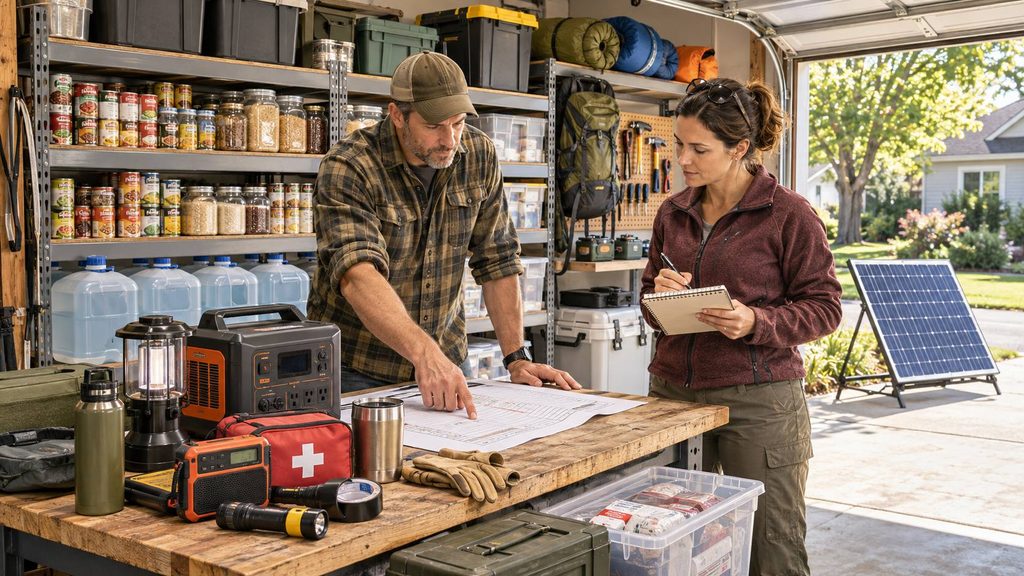
That’s three months of feeding everyone, maintaining safe living conditions, keeping essential equipment running, and handling the ordinary needs that don’t disappear just because outside services become unavailable.
In September 2026, the Department of War announced FORTRESS America, an initiative focused on strengthening military infrastructure, energy independence, supply chains, and strategic reserves. Although designed for national defense rather than civilian preparedness, the initiative raises an interesting question for anyone interested in self-reliance.
What would it actually take to make your own household self-sufficient for 90 days?
The answer involves considerably more than filling a pantry or stacking cases of bottled water. It requires understanding what your household consumes, which services it depends on, and what you’ll need to keep essential systems functioning. Let’s put that challenge into perspective.
Resources in this post:
- 90-Day Household Resource Calculator
- 90-Day Household Self-Sufficiency Assessment & Progress Tracker (printable)
What Does 90-Day Self-Sufficiency Actually Mean?
For an ordinary household, 90-day self-sufficiency means having the resources, equipment, skills, and contingency arrangements necessary to maintain essential living conditions through a prolonged disruption of normal utilities and resupply.
We’re not necessarily talking about living completely off-grid, producing every calorie of food, or giving up modern conveniences permanently.
We’re talking about sustaining the household’s essential needs for approximately three months without assuming that stores, deliveries, utilities, or repair services will remain consistently available.
That distinction matters because every household starts from a different position.
A suburban home might have room for bulk food storage, water containers, and backup power equipment. An apartment offers fewer storage and equipment options but can still support meaningful preparedness. A rural homestead may have access to land, a private well, and alternative heating, yet remain dependent on electricity, fuel, and mechanical equipment.
The people living there matter just as much. Children, older adults, individuals with medical needs, and pets all influence what supplies and capabilities are required.
The first step is understanding what your household needs to remain functional, rather than purchasing an arbitrary quantity of emergency supplies.
And once you begin examining those needs, the scale of a 90-day commitment becomes much more apparent.
Ninety Days of Supplies: The Numbers Add Up Quickly
Food and water are the obvious starting points because everyone consumes them daily.
Consider two relatively simple illustrations.
For food, assume an average of 2,000 calories per adult per day. That isn’t a universal dietary recommendation; actual requirements vary with age, activity, health, and individual circumstances.
For water, the CDC recommends storing at least one gallon per person daily for short-term emergencies, with additional provisions for certain conditions and household needs.
Extend those assumptions across 90 days, and the numbers become substantial.
| Household | Food (2,000 Calories per Adult/Day) | Water (1 Gallon per Person/Day) |
|---|---|---|
| Two Adults | 360,000 Calories | 180 Gallons |
| Four Adults | 720,000 Calories | 360 Gallons |
scroll table left and right for more info
These calculations are illustrations, not official 90-day preparedness standards. The water figures extend the CDC’s short-term emergency planning baseline; they do not establish enough water for all long-term sanitation, hygiene, and household activities.
Now consider that 360 gallons of water weigh approximately 3,000 pounds, excluding containers.
That’s a considerable storage challenge before you’ve accounted for food, equipment, clothing, medical supplies, or anything else.
And that’s only food and water.
A 90-day food supply must provide more than an adequate number of calories. It needs sufficient nutritional variety, proper storage, and food that your household will actually eat.
Dry rice and beans can contribute substantial calories, but they also require cooking water, fuel, and preparation equipment. Refrigerated and frozen foods introduce another dependency: electricity or a reliable alternative means of preservation.
Children cannot simply be assigned the same nutritional requirements as adults. Infants may require formula and specialized sanitation arrangements. Household members with dietary restrictions require food selected for those needs.
Pets also need their own provisions. Dog food, cat food, medications, drinking water, and waste supplies must be calculated separately rather than treated as leftovers from the human budget.
Our guide to Caloric Planning for Families in a Crisis explores the food calculations in greater detail.
Water presents an equally important challenge.
If storing every gallon for three months is impractical, your plan may need dependable alternative sources, appropriate storage containers, and a method of making collected water safe for its intended use.
A nearby stream or rain barrel isn’t automatically a potable water supply. Different contaminants require different treatment methods, and some cannot be removed by ordinary boiling or disinfection.
Our Water Security foundation examines storage, sourcing, purification, and redundancy.
There’s an important purchasing lesson here: quantities matter, but so do the containers, tools, treatment supplies, and equipment that make those quantities useful.
Buying more isn’t always the answer. Buying the right things, in the right order, is what moves the household closer to its objective.
90-Day Household Resource Calculator
Estimate your household’s food energy and emergency water needs. Adjust the inputs to see what preparing for 90 days could require.
Your Existing Reserves
Your Estimated Requirements
Your total emergency water baseline weighs approximately 1,501 pounds, excluding containers.
Planning Note: These are illustrative estimates, not individualized dietary recommendations or official 90-day preparedness standards. Calorie requirements vary by age, activity, and health. Water calculations extend the CDC’s short-term baseline of one gallon per person daily and exclude additional cooking, hygiene, sanitation, climate-related, medical, and pet needs. Nutritional adequacy, food preparation, storage losses, and the safety and usability of existing reserves must be evaluated separately.
Beyond the Stockpile: Keeping Your Household Running
Food and water are only part of the equation.
Consider how many everyday activities depend on systems operating quietly in the background.
Your refrigerator preserves food. Electricity powers communications and essential equipment. Heating and cooling maintain safe indoor conditions. Plumbing removes waste. Vehicles provide transportation, while tools and spare parts help keep equipment working.
A three-month household preparedness plan must account for these functions, even if the objective is to maintain essential services rather than every modern convenience.
Power, Fuel, and Temperature
Backup power is a useful example of the difference between possessing equipment and understanding its endurance.
A portable generator might provide ample electricity for essential appliances, but how much fuel will it consume? How long can you operate it with your available supply? What happens if maintenance becomes necessary or fuel deliveries stop?
A battery power station avoids many of the complications associated with fuel-powered generators, but its stored energy is finite. Recharging it requires another dependable source.
Solar generation can help extend electrical independence, although sunlight, weather, battery capacity, and equipment limitations all affect performance.
The practical approach begins by identifying which appliances and devices genuinely need electricity, then determining their actual energy consumption.
Our article on Solar Power Basics for Off-Grid Preppers provides a deeper introduction to backup energy systems.
Heating and cooling can be particularly demanding. Keeping a few lights and radios operating is very different from heating an entire house during a winter outage.
Any alternative heating or power arrangement must also be appropriate for the building and operated safely. Fuel-burning generators belong outdoors, well away from doors, windows, and ventilation openings, because carbon monoxide can be deadly.
Sanitation and Household Hygiene
Now imagine having plenty of clean drinking water, but no functioning toilets.
Municipal sewage interruptions, compromised septic systems, or limited water pressure can create problems that bottled water alone cannot solve.
Handwashing, cleaning, bathing, human waste disposal, pet waste, and ordinary household sanitation all require planning.
The equipment involved may be relatively simple, but the procedures need to be safe, practical, and appropriate for your living situation.
A preparedness plan that accounts for drinking water while overlooking wastewater management has a significant gap.
Medical Needs, Communications, and Maintenance
The longer the planning period, the more important it becomes to address needs that ordinary emergency kits cannot fully resolve.
First-aid equipment and training are useful starting points. Prescription continuity, medical-device power, refrigeration requirements, and access to essential treatments require additional consideration.
Some medical services cannot realistically be replaced at home. Those dependencies deserve advance planning with qualified healthcare providers.
The same principle applies to communications. Maintaining a charged phone is useful, but cellular service might be unavailable. A battery-powered radio, alternative communication arrangements, and a written family contact plan can provide additional options.
Our Medical Preparedness foundation and Family Emergency Messaging Plan examine these subjects more closely.
Finally, think about maintenance.
Water filters require replacement elements. Flashlights need batteries. Cooking equipment needs fuel. Tools wear, seals leak, and even reliable equipment occasionally fails.
Three months is long enough for ordinary wear, weather, and unexpected problems to expose weaknesses in a plan.
Your objective isn’t to own every possible backup device. It’s to know which essential capabilities depend on particular equipment and how you’d maintain them if replacement parts or professional assistance were unavailable.
What Could Keep Your Household From Reaching Day 90?
This is where the 90-day challenge becomes a useful measure of preparedness.
Imagine a suburban household with a stocked pantry, several hundred gallons of water, and a generator.
At first glance, that’s an impressive foundation.
But suppose the family never calculated its generator’s fuel consumption. After several weeks, the available fuel is gone, leaving refrigeration, water pumping, or other essential functions unsupported.
Or consider a rural property with a private well. The household may have a dependable groundwater source, but if its pump requires electricity and no alternative exists, that water may become inaccessible during an extended outage.
An apartment presents another situation. Stored supplies might be sufficient for months, yet inadequate cooling during a prolonged summer power failure could make the building unsafe for vulnerable occupants or pets.
None of these examples means the 90-day objective is unrealistic.
They illustrate the importance of recognizing which household functions are vulnerable and developing appropriate alternatives before those functions are interrupted.
A useful way to evaluate each system is to ask four questions:
- What does this system need to accomplish?
- What resources or equipment does it depend on?
- How long could it realistically continue operating?
- What alternative would you use if it stopped working?
This exercise can expose weaknesses that aren’t apparent when simply counting stored supplies.
It also helps separate purchases that improve genuine capability from equipment that merely looks useful.
There are limits to what any household can control. Serious medical needs, dangerous indoor conditions, contaminated water, or failed sanitation may require outside assistance or relocation. Recognizing those circumstances is part of responsible planning, not a reason to stop pursuing self-sufficiency.
The larger objective remains the same: develop a household capable of sustaining essential functions for as much of the 90-day planning horizon as reasonably possible.
The more vulnerabilities you address in advance, the stronger that capability becomes.
Building Toward 90 Days: Where Do You Start?
If your household currently has enough provisions for a few days, don’t immediately start purchasing three months of everything.
Build from where you are.
A 72-hour reserve establishes a useful starting point. Extending it to two weeks provides greater flexibility. Thirty days introduces more substantial questions about consumption, storage, maintenance, and replenishment.
Ninety days becomes the longer-term objective toward which those improvements contribute.
The progression isn’t simply about accumulating more supplies at each milestone. It’s about adding capabilities.
Perhaps your first improvement is properly stored drinking water. Next comes a more deliberate food reserve, a reliable cooking arrangement, or dependable emergency lighting.
Then you might investigate water treatment, communications equipment, backup energy, additional medical supplies, or practical household tools.
Each purchase should solve a problem you’ve actually identified.
You can also learn a great deal without spending money.
Prepare meals using your stored ingredients. Measure how much drinking and cooking water your household consumes. Test your emergency lighting, inspect equipment, and practice using communication arrangements.
Do these exercises safely, without deliberately interrupting essential utilities or medical systems.
Over time, you’ll begin identifying which preparations are working and which require attention.
Put Your 90-Day Plan on Paper
Download our free 90-Day Household Self-Sufficiency Assessment & Progress Tracker to evaluate your household’s essential capabilities, identify weak points, and track progress from 72 hours to 90 days.
Print it, keep it with your emergency supplies, and revisit it as your household becomes more self-sufficient.
For additional guidance, explore our 10 Pillars of Preparedness. This framework connects food, water, medical care, power, shelter, communication, skills, mobility, security, and community into a broader approach to self-reliance.
You don’t need to master every subject immediately. Start with the capability that would make the greatest practical difference in your household.
And when you identify equipment or supplies worth adding, explore the MidAtlanticMunition storefront for preparedness gear, tools, accessories, and other products that fit your plan.
Ninety days of self-sufficiency is a substantial undertaking. That’s what makes it a worthwhile challenge.
Start by discovering what your household can already sustain. Identify what would need improvement to extend that endurance, then make deliberate progress.
Three months of independence won’t come from a single shopping trip.
But the supplies, equipment, skills, and systems you develop along the way can make your household considerably more resilient—even before you reach day ninety.
Safety note: This article provides general preparedness education, not individualized medical, engineering, or emergency-management advice. Follow applicable laws, manufacturer instructions, official emergency directives, and qualified professional guidance when developing household systems.