
Buying ammunition only when you need it puts someone else in control of what you pay—and whether you can shoot at all. Think about that for a moment.
If your ammunition supply consists of one dusty box in the closet, you’re effectively betting that affordable ammunition will be available whenever you decide you need more. Maybe it will be. Maybe it won’t. And if your plan is to buy another box when you get to the shooting range, there’s a good chance you’re paying a premium for the privilege.
Here’s the uncomfortable truth: you probably need more ammunition at home than you think. Not because the world is ending tomorrow, but because relying on somebody else’s inventory and pricing is a lousy way to manage your own. Let’s look at the numbers.
Resources in this post:
The Range Counter: Where Convenience Gets Expensive
Imagine walking into a grocery store, paying an admission fee, and then discovering the milk costs substantially more than it does down the street. Welcome to buying ammunition at some shooting ranges.
Ranges have legitimate operating expenses. They provide facilities, equipment, supervision, and services worth paying for. But that doesn’t mean their ammunition counter is automatically the smartest place to buy cartridges.
In November 2026, Tactical Surplus USA reported a median listed price of $0.28 per round for in-stock 9mm FMJ range ammunition—equivalent to $14 per 50 rounds. Now consider these publicly advertised shooting-range prices:
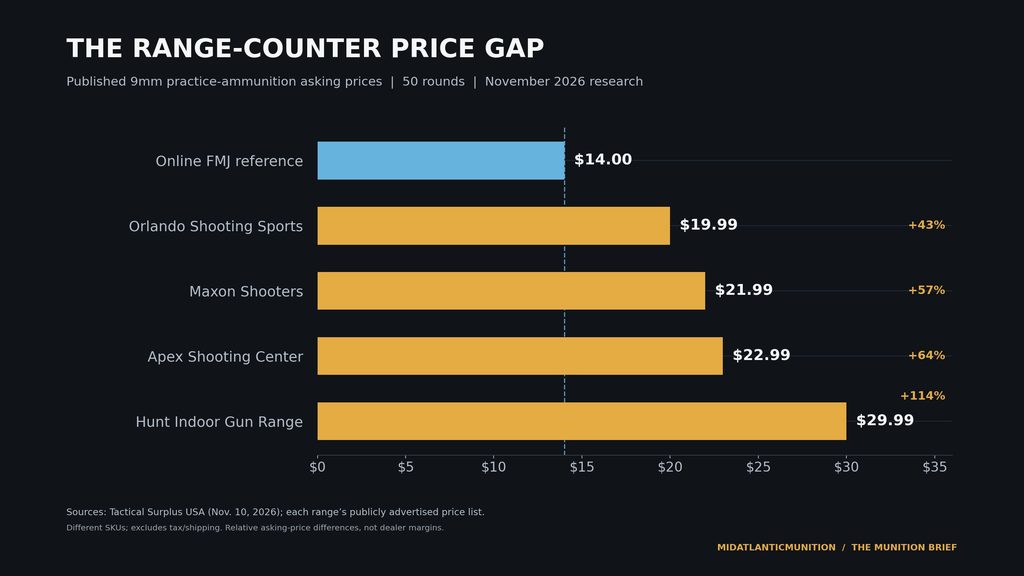
At the high end, that’s 114% more than the online reference for the same quantity of ammunition. Not 14%. Not 40%. More than double.
These are published asking prices, not verified wholesale markups. The ammunition isn’t necessarily the same brand or load, and shipping and taxes can affect actual savings. But the advertised price differences are real.
Now multiply the difference by twenty boxes. That’s 1,000 rounds. At the $14 online reference, those rounds cost $280 before shipping and taxes. At the highest published range-counter price above, they cost $599.80.
That’s a $319.80 difference before delivery and taxes.
Money that could have stayed in your pocket, covered additional range visits, or paid for other shooting expenses.
Some ranges also require customers renting firearms to purchase ammunition on-site. There can be legitimate safety and liability reasons for those policies, but they also limit the customer’s purchasing options.
Here’s the point: you already paid to use the range. Why pay substantially more for ammunition because you arrived without any?
[Sources: Tactical Surplus USA Ammo Price Index, November 10, 2026; Orlando Shooting Sports; Maxon Shooters; Apex Shooting Center; Hunt Indoor Gun Range.]
When the Ammunition Market Goes Sideways
Range-counter pricing is the predictable problem. The ammunition market itself is the unpredictable one. And if you think ammunition shortages are some once-in-a-lifetime phenomenon, history would like a word.
The 2007–2009 disruption: Ammunition prices rose sharply amid increasing production costs and strong demand. Shortages and purchasing restrictions became familiar to shooters as retailers struggled to maintain inventory.
The 2012–2014 disruption: According to Ammunition Depot’s historical pricing series, average 9mm prices climbed from approximately $0.23 per round in early 2012 to $0.73 in April 2013—an increase of roughly 217%. Prices didn’t return near their earlier level until August 2014.
The 2020–2023 disruption: The same dataset shows 9mm climbing from $0.19 in January 2020 to $0.89 in February 2021—a staggering 368% increase. It took until April 2023 for average pricing to fall below $0.30 again.
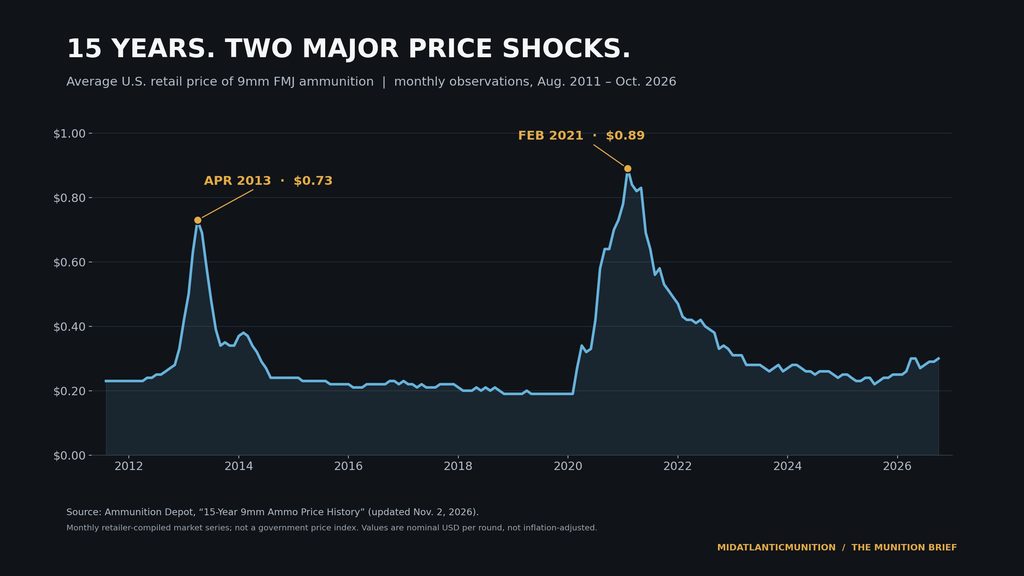
These weren’t identical events, and they didn’t have identical causes. Changes in demand, manufacturing capacity, distribution, and broader economic conditions all played roles. But they share an important lesson: when ammunition demand overwhelms supply, the customer who needs to buy right now has fewer options.
This isn’t merely retailer folklore. Olin Corporation, the parent company of Winchester Ammunition, disclosed that its contracted Winchester order backlog increased from approximately $151 million in January 2020 to $2.175 billion in January 2021. That’s more than fourteen times larger in one year.
Olin also warned that production-capacity constraints could limit its ability to fulfill those orders. And that backlog included contractual orders not yet shipped—not just ammunition missing from sporting-goods shelves. The pipeline was under genuine pressure.
[Sources: Ammunition Depot historical 9mm price series; Olin Corporation 2020 Form 10-K.]
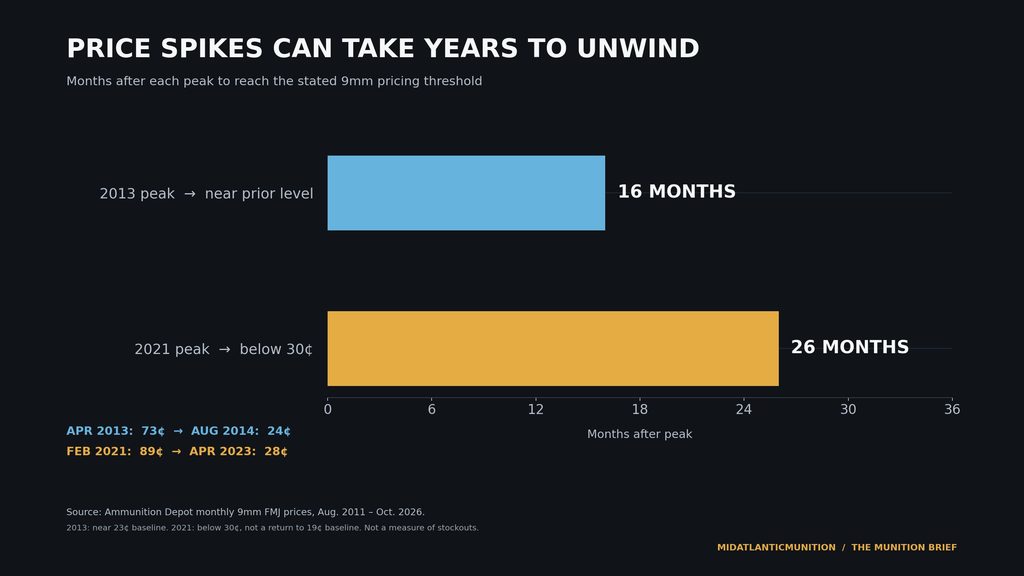
There’s another distinction worth remembering: ammunition becoming available again doesn’t necessarily mean its price has returned to normal. Following the April 2013 peak, it took approximately sixteen months for the reported average 9mm price to return near its early-2012 level. Following the February 2021 peak, it took twenty-six months just to drop below $0.30 per round—still well above the $0.19 pre-pandemic baseline.
Nobody knows when the next disruption will happen, which calibers it will hit hardest, or how long recovery will take. That’s precisely why waiting until you need ammunition can be an expensive gamble.
So How Much Ammunition Should You Actually Keep?
Now we get to the question everybody wants answered. A hundred rounds? Five hundred? A thousand? More? The answer shouldn’t come from somebody on the internet announcing a magic number. It should come from the two problems we’ve just documented.
First, how much ammunition would let you enjoy your normal shooting activities without repeatedly relying on expensive last-minute purchases? Second, how much would you need to maintain those activities through a period of unfavorable pricing or limited supply? Those are measurable questions.
If you know how often you shoot and roughly how many rounds you use, we can estimate what several months—or even a year or more—of normal consumption looks like. Then we can compare that with historical ammunition-market disruptions and show you what different planning horizons would mean for your own inventory.
That’s what our Ammunition Reserve Calculator is designed to do. Instead of asking you to invent a stockpile target, it uses your normal shooting habits and historical market scenarios to estimate how much ammunition would cover those activities without replenishment.
The result isn’t a prediction about the next shortage or a prescribed quantity for an emergency. It’s a practical answer grounded in your own use and what previous markets have done.
How Much Ammo Should You Keep on Hand?
Start with how much you actually shoot. See the ammunition needed to avoid last-minute range purchases and to cover historical market-disruption scenarios.
Your Ammunition
1 entryYour Ammunition Plan
Enter your shooting habits and inventory to see your results.
A. Avoid the Range Counter
Buy-ahead bufferB. Ride Out Market Disruptions
Historical reference scenarios*The 2021 figure measures the time until average 9mm prices fell below 30¢ per round, not a full return to the pre-pandemic price. These periods illustrate past pricing conditions—not predictions or recommended stockpile sizes.
Don’t add A and B together. Both scenarios draw on the same ammunition inventory. Each result shows a separate way to measure your existing supply.
Estimates assume steady shooting habits and no replenishment during the selected period. All quantities are for routine, lawful shooting activities—not defensive or emergency ammunition requirements. Track distinct purposes separately, use ammunition suitable for your firearm, and store it securely. Historical periods are drawn from the 9mm price history discussed in this article and may not reflect other calibers.
You may discover that you’re already well positioned. Or you may discover that the ammunition you thought would last all year wouldn’t cover a few ordinary range outings. Either way, knowing beats guessing.
Buy on Your Terms, Not Theirs
MidAtlanticMunition exists in part because we got tired of unnecessary ammunition markups. Our ammunition department operates on a flat 10% markup over acquisition cost. We believe customers deserve straightforward pricing, not a financial penalty for failing to plan ahead.
Buying ahead doesn’t mean buying everything today. It means comparing your total delivered cost, purchasing responsibly when prices make sense, keeping an organized supply, and replenishing it before you’re forced into an unfavorable transaction. That’s not panic buying. That’s taking control of your purchasing decisions.
Explore ammunition options at MidAtlanticMunition, compare prices, and build a supply that makes sense for your shooting habits, finances, and storage capabilities.
Because whether it’s a range-counter premium or another disruption in the ammunition market, the principle remains the same: The best time to decide how much ammunition you need isn’t when somebody else controls the supply.
When you’re done here, check out our Ammo Usage Calculator in How to Buy Ammunition: A No-Nonsense Guide for New and Experienced Shooters