
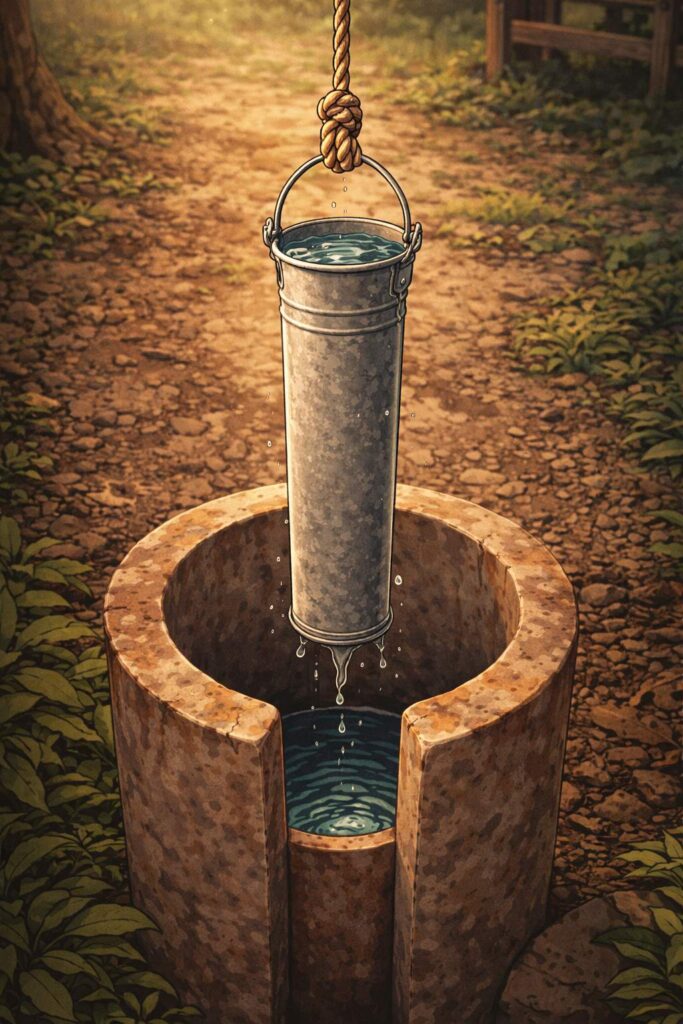
What It Is
A well bucket is a narrow, weighted container, sometimes with a one-way valve, that fills with water as it’s lowered into a well and holds it as it’s pulled back up.
What It’s Used For
This tool exists for one job—getting water out of a well when your pump can’t.
Common uses include:
- Drawing water from a well during power outages
- Accessing water from wells without active pumping systems
- Providing emergency backup when electric or submersible pumps fail
- Supplying small amounts of water for drinking, cooking, or basic needs
It’s not meant for daily use—it’s there for when your normal system stops working.
Why It Matters
Most modern wells depend entirely on electricity. Flip a switch, water flows. It’s easy to assume that’s permanent. It’s not.
When power goes out—or when the system feeding your pump fails—your well doesn’t stop holding water. You just lose the ability to reach it.
That’s the gap a well bucket fills. It turns a powered system back into a manual one. No wiring, no pump, no pressure tank—just gravity and a tool that’s been around in one form or another for a long time. That capability is hard to replace.
Water is one of the few resources you can’t wait on. If you have a well, you already have the source. A well bucket gives you a way to access it when everything else is offline.
It’s not fast. It’s not convenient. But it works. And that’s the point.
In a disruption, you’re not looking for efficiency—you’re looking for reliability. Being able to pull even a small amount of water by hand can carry you through short-term outages and buy time for longer-term solutions.
It also changes how you think about your setup. Instead of relying on a single system, you’re building in a fallback—something simple that doesn’t fail the same way.
What to Know Before You Get One
A well bucket is straightforward, but there are a few important realities to understand:
- It has to fit your well
Diameter matters. Not all wells will accommodate every bucket. - Your pump setup may interfere
In some cases, a submersible pump or piping may need to be removed before using a bucket. - It’s for emergencies, not daily use
This is a backup method. It’s slower and more labor-intensive than a pump. - Depth matters
Deeper wells mean more effort. You’re lifting water by hand. - Capacity is limited
You’re bringing up small amounts at a time. Plan accordingly. - You need a way to lower and retrieve it
Rope quality (type) and handling (strength and coordination) matter more than people expect.
Check out Lehman’s Amish-Made Galvanized 1.9 Gal Well Bucket
This isn’t a replacement for your primary system. It’s a safeguard.
If you have a well, you’re already ahead. Adding a simple, manual way to access that water closes a critical gap that most people don’t think about until it’s too late.
Read up on Well Water Safety and Testing for Preppers
Disclaimer: As an Amazon Associate we earn from qualifying purchases. This doesn’t change your price – it helps support the site.