
When the water stops flowing, having a reliable supply of drinking water becomes an immediate priority. That’s why emergency water storage deserves attention long before a storm approaches or a utility interruption catches a household off guard.
One product frequently recommended for this purpose is WaterBOB, a disposable plastic reservoir designed to hold up to 100 gallons of water inside an ordinary bathtub. It’s compact when packaged, relatively inexpensive, and capable of storing a substantial amount of water when filled.
But I’ve never been particularly enthusiastic about the concept.
My concern with WaterBOB is that it asks you to anticipate an emergency, sacrifice the use of your bathtub, and commit to a single-use product when reusable alternatives could already be holding water before trouble arrives.
For some households, especially those with limited storage space, WaterBOB’s temporary capacity may be appealing. But convenience before deployment doesn’t necessarily translate into convenience during an emergency.
Before spending money on one, I’d consider what you’re giving up, what happens if your plans change, and whether another storage approach would serve your household better.
Why I Question WaterBOB as an Emergency Water Storage Solution
WaterBOB is essentially a large, food-grade plastic bladder that fits inside a bathtub. It’s filled from the bathtub faucet, and an included siphon pump allows water to be transferred into smaller containers.
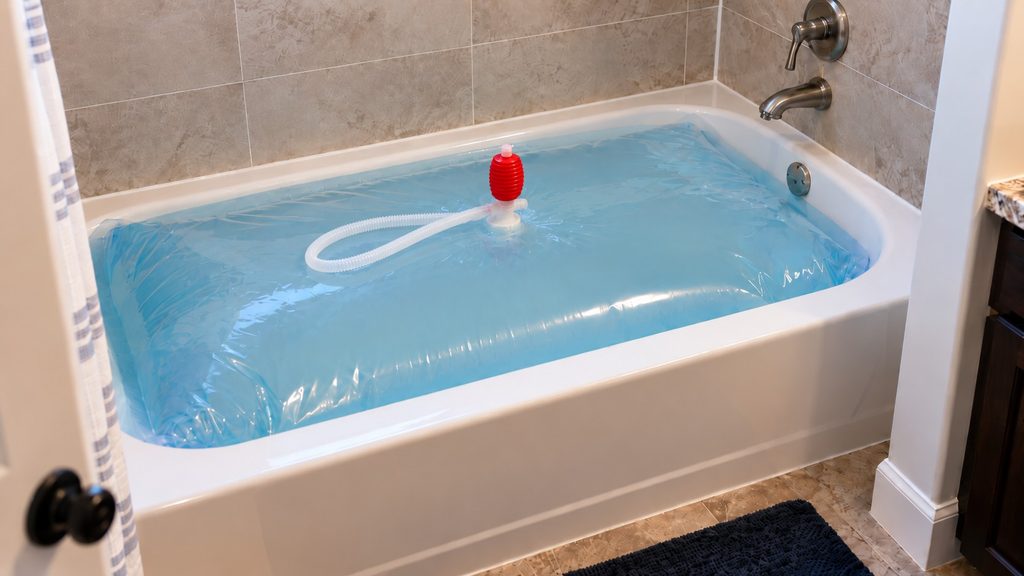
The manufacturer advertises a capacity of up to 100 gallons, depending on bathtub dimensions, and a filling time of approximately 20–30 minutes. The reservoir separates stored drinking water from the bathtub’s surfaces, which is certainly preferable to storing potable water directly in an ordinary tub.
The product accomplishes its intended purpose. My objections concern the practical decisions surrounding its use.
One Emergency, One Reservoir
WaterBOB is designed for one-time use.
That creates an awkward purchasing proposition. Suppose severe weather is approaching and your community warns of possible water-service interruptions. You install the reservoir and fill it.
The storm passes. The water stays on.
You’ve taken a reasonable precaution, but now you’re left with a filled bathtub and a reservoir that wasn’t designed to be cleaned, dried, and stored for the next emergency.
The water needn’t be wasted. It can still be used for drinking, cooking, cleaning, or other appropriate household needs while it remains safe. Eventually, however, the bladder must be drained or emptied and discarded.
With reusable containers, the same false alarm is considerably less disruptive. You can retain the stored water under appropriate conditions, rotate it when necessary, and keep the containers ready for future use.
That distinction matters when you’re trying to build a dependable preparedness system without continually replacing equipment.
Your Bathtub Has Other Jobs
Consider what happens when your only bathtub becomes a 100-gallon water reservoir.
You lose a place to bathe, shower, wash children, rinse soiled clothing, and handle certain household cleaning tasks. Depending on your plumbing situation and available supplies, the tub might otherwise be useful for temporarily holding non-potable water for cleaning or toilet flushing.
Those uses can become more important during an extended utility interruption.
For a household with multiple bathrooms, occupying one bathtub might present little inconvenience. But a small apartment or modest home with one bathtub-and-shower combination presents a different situation.
Parents with young children may find the arrangement especially inconvenient. Daily hygiene doesn’t stop because the water supply becomes unreliable, and caring for an infant or toddler can make access to washing facilities particularly valuable.
Of course, families can improvise with washcloths, basins, and other arrangements. I’d still rather preserve a useful household fixture if practical alternatives are available.
You Have to Fill It Before the Water Stops
This is my biggest objection.
A WaterBOB sitting unopened in a closet provides no emergency drinking water. You must anticipate an interruption and fill it while the water supply is still functioning and safe.
That works reasonably well when an approaching storm provides adequate warning. It does little for a water main failure, an unexpected municipal supply interruption, or an electrical outage that immediately disables a household’s well pump.
If officials issue a contamination advisory before you’ve filled the reservoir, storing water from that source may be unsafe.
And there’s another possibility: you successfully fill the bathtub, only to face an evacuation order. A collapsed roof, serious flooding, fire, or other damage could make your home uninhabitable.
You might have time to transfer a few gallons into portable containers. The rest stays behind.
A large stationary reserve can certainly support sheltering at home. But if leaving becomes necessary, water you can carry has considerably more value than water trapped in a bathtub.
Here’s the question I’d ask before purchasing any emergency water-storage product: If your tap stopped working tonight, how much safe drinking water would you already have available?
If the answer is little or none, that’s where I’d begin.
Choosing an Emergency Water Storage Alternative
There are several practical ways to store emergency water without depending on a disposable bathtub reservoir. Each offers a different balance of capacity, cost, portability, and available space.
The first consideration is how much water you need.
The Centers for Disease Control and Prevention recommends storing at least one gallon per person per day, maintaining a minimum three-day supply, and aiming for two weeks when possible. Hot weather, illness, pregnancy, pets, and additional sanitation requirements can increase those needs.
For a four-person household, the basic two-week calculation is straightforward:
4 people × 1 gallon × 14 days = 56 gallons.
That may sound intimidating, particularly for apartment dwellers or households on tight budgets. Fortunately, building a reserve doesn’t require purchasing 56 gallons of storage capacity all at once.
The second consideration is whether the water will be ready when needed.
A full, properly maintained container provides an immediate reserve. An empty tank, collapsible bladder, or bathtub reservoir still needs a functioning water source.
Then consider portability and accessibility. Five gallons of water weighs approximately 42 pounds before accounting for the container. A 55-gallon barrel contains roughly 459 pounds of water. Capacity becomes much less impressive when you cannot safely move, access, or dispense what you’ve stored.
Finally, consider the equipment’s useful life. A durable container that can be cleaned and refilled may cost more initially but serve through multiple emergencies.
These considerations point toward several alternatives worth examining.
Bottled Water and Reusable Portable Containers
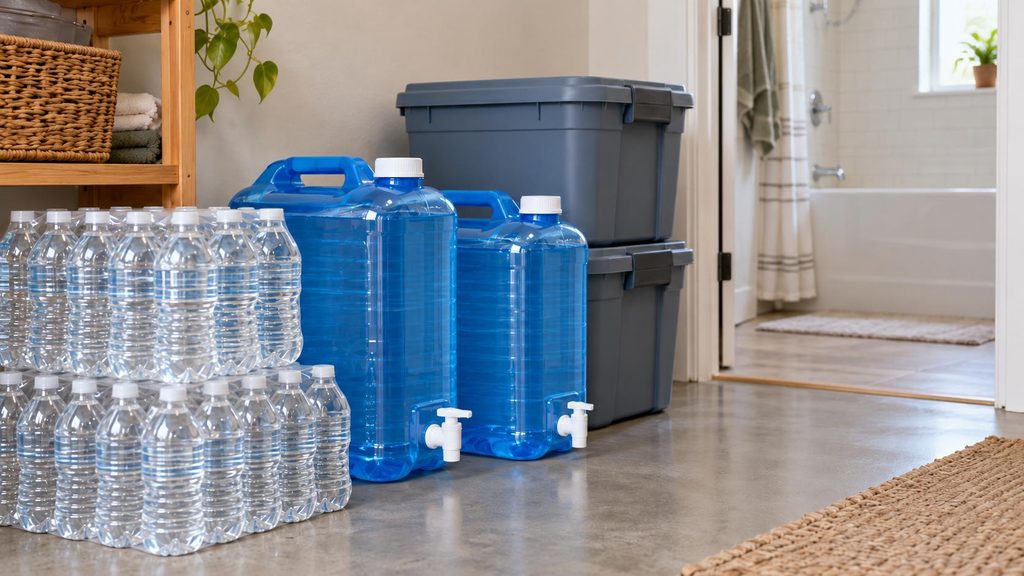
Commercially bottled water offers the simplest starting point. It’s available in manageable quantities, requires no emergency filling procedure, and can accompany you during an evacuation.
Its limitations include packaging waste, recurring expense, and the physical space needed for larger reserves. Still, a few cases of bottled water stored in a suitable location provide immediate protection that an empty reservoir cannot.
Reusable water containers are the next logical step.
Five-to-seven-gallon food-grade containers provide useful capacity without committing to a permanent tank. Many include handles, dispensing spigots, or other features that make retrieving water more convenient.
For someone with limited strength or mobility, smaller one-to-three-gallon containers may be more practical. An accessible shelf and a reliable dispensing arrangement can make a modest water reserve far more useful than a large container that’s difficult to lift.
Modular, stackable water containers offer another option for smaller homes. Their shape can make better use of closets, utility rooms, and other available spaces. They’re generally more expensive per gallon than basic jugs, but their flexibility can justify the additional expense.
These are the categories I’d examine first when shopping for emergency water storage.
Larger Tanks and Reusable Collapsible Reservoirs
For households with suitable space, food-grade barrels and dedicated water tanks offer substantial stationary capacity.
A 55-gallon drum can hold nearly the entire basic two-week water allowance for four people. However, its considerable filled weight requires an appropriate location, suitable floor support, and a practical way to dispense the water.
Reusable collapsible reservoirs provide another possibility. Models specifically designed for repeated potable-water storage can offer temporary capacity while taking up less room when empty.
Their durability, cleaning requirements, materials, and dispensing arrangements deserve scrutiny. And unless they’re maintained full, they share WaterBOB’s dependence on having water available when it’s time to fill them.
For a more detailed examination of portable jugs, water bricks, barrels, and tanks, see Best Containers for Long-Term Water Storage.
Comparing WaterBOB With Other Water Storage Options
The practical differences become easier to evaluate when each approach is judged by its readiness and usefulness during an emergency.
| Storage Approach | Ready Without Advance Warning? | Reusable? | Best Application | Main Limitation |
|---|---|---|---|---|
| WaterBOB Bathtub Reservoir | No, unless already filled | No | Temporary shelter-in-place storage | Occupies bathtub; single-use |
| Commercially Bottled Water | Yes, if stocked | Generally disposable packaging | Immediate drinking water and evacuation | Space and recurring expense |
| Reusable Portable Containers | Yes, if maintained full | Yes | Household reserves and transportable water | Weight when filled |
| Modular Stackable Containers | Yes, if maintained full | Yes | Expandable storage in limited spaces | Higher upfront cost |
| Food-Grade Barrels or Tanks | Yes, if maintained full | Yes | Large stationary reserves | Weight, space, and dispensing |
| Reusable Collapsible Reservoirs | Only if maintained full | Yes, when designed for reuse | Supplemental capacity | Cleaning, durability, and filling requirements |
Scroll left and right to see more content.
WaterBOB has an undeniable advantage in temporary storage capacity relative to its purchase price. A reusable system capable of holding 100 gallons may cost significantly more.
But I’d rather compare what those dollars accomplish over time.
A few reusable containers can serve for years when properly maintained. Bottled water provides immediate access and portability. A dedicated tank can hold water before an interruption occurs.
A disposable bathtub reservoir provides one opportunity to capture water, provided the circumstances allow it.
For me, that limitation substantially reduces its appeal.
Building a Water Reserve Around Your Household
Different living arrangements call for different solutions, and affordability should be part of the discussion.
For someone renting their first apartment on a limited budget, I’d recommend starting small. A few gallons of commercially bottled water are better than an empty closet full of ambitious preparedness plans. Adding another case or a smaller reusable container when finances permit gradually builds a meaningful reserve.
That approach also avoids sacrificing the apartment’s only bathtub.
A rural renter relying on an electrically powered well faces another problem: the supply may stop immediately when electricity fails. Keeping water filled and ready can be particularly important when there is no municipal system providing pressure during an outage.
Older residents and anyone with physical limitations should give careful thought to container size, placement, and dispensing. Several smaller containers within easy reach may be more useful than one large reservoir. Equipment that requires heavy lifting can create problems precisely when outside assistance is unavailable.
Families with young children need to account for additional hygiene demands, supplies for infant feeding where applicable, and the possibility of evacuating with limited notice. Portable water should remain part of that planning.
An experienced prepper with an established reserve might have little difficulty incorporating temporary storage into an already layered system. But that household has probably addressed the more important vulnerabilities first.
Whichever containers you choose, stored water requires maintenance.
The CDC advises using containers suitable for drinking water, cleaning and sanitizing them before filling, labeling them, and storing them away from sunlight, heat, and chemical contamination. Water filled into household containers should be replaced every six months under its guidance. Commercially bottled water should be managed according to its labeling.
Don’t overlook the difference between potable and non-potable supplies. Water intended for cleaning or toilet flushing may have different requirements from water used for drinking, food preparation, and brushing teeth.
And remember that stored water is finite.
A household should eventually develop ways to replenish supplies and treat water from appropriate sources if an interruption extends beyond the initial reserve.
Our guide to How to Store Emergency Water for 30+ Days explores longer-term planning, while Redundant Water Filtration: Why One Method Isn’t Enough explains how multiple treatment capabilities support water security.
My Recommendation: Buy Water Storage You’ll Actually Use
I understand why WaterBOB appeals to people. One compact package promises up to 100 gallons of emergency water storage for a relatively modest purchase price.
But the more I consider its limitations, the less sense it makes to me as an early preparedness purchase.
I’d rather own several reusable containers that are already filled, know exactly where my drinking water is stored, and have the flexibility to take at least some of it with me.
I also value keeping my bathtub available, especially when a utility interruption could complicate personal hygiene and household sanitation.
And I don’t particularly like the idea of buying equipment that may be consumed by an emergency that never materializes.
My preference is straightforward: purchase and maintain a usable water reserve before investing in temporary storage that depends on advance warning.
For households just getting started, that might mean bottled water and a few affordable reusable jugs. Others may find modular containers or larger tanks more appropriate. The right choice depends on available space, household needs, and the emergencies most likely to affect your area.
Start with something manageable, maintain it properly, and expand your capacity as circumstances allow.
For a broader discussion of sourcing, storage, and treatment, visit Water Security: The Foundation of Preparedness.
Water safety note: Store emergency drinking water in containers intended for potable use. Follow manufacturer instructions and current public-health guidance for collection, sanitation, storage, and treatment. Water affected by flooding, chemical contamination, or other hazards may remain unsafe even after ordinary filtration or boiling.