
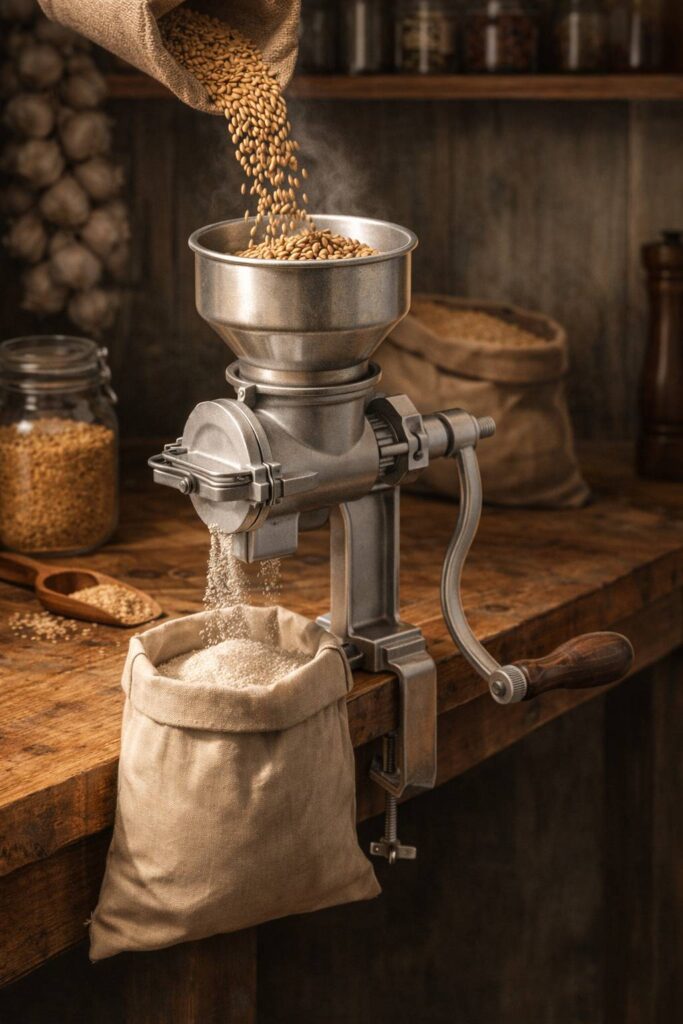
What It Is
A compact, clamp-on grain mill that lets you grind non-oily grains and seeds by hand into flour or meal.
What It’s Used For
This type of mill gives you a straightforward way to turn whole grains into something usable in the kitchen.
Common uses include:
- Grinding wheat, corn, and other grains into flour or meal
- Making fresh cornmeal, oat flour, or cracked grain
- Small-batch processing for daily cooking or baking
- Learning how different grains behave when milled
- Reducing reliance on pre-packaged flour products
It’s a simple tool—grain goes in, usable food comes out.
Why It Matters
Flour is one of those things most people take for granted. It’s always on the shelf—until it isn’t. And even when it is, it’s already processed, aged, and dependent on a supply chain you don’t control.
A grain mill shifts that.
Instead of relying on finished products, you’re working with raw inputs—whole grains that store longer, travel better, and give you more flexibility. You’re not just buying food; you’re controlling part of the process.
Starting with a compact mill makes sense. It lowers the barrier. You don’t need a dedicated setup or a large investment. You can begin with small amounts, learn how it feels, and build from there.
There’s also a quality factor. Freshly milled flour behaves differently. It has more texture, more flavor, and a different kind of usefulness in the kitchen. You notice it right away.
In a disrupted setting, this becomes more than preference. If packaged flour is unavailable or limited, being able to process grain yourself keeps you moving. It turns stored grain into usable calories without relying on external systems.
It’s not about replacing modern convenience—it’s about having a fallback that works when convenience disappears.
What to Know Before You Get One
A compact grain mill is a good entry point, but it comes with a few tradeoffs:
- It’s manual work
You’re turning a handle. Fine for small batches, but not ideal for large volumes. - Not all grains behave the same
Dry grains work well. Oily seeds don’t. Understanding that upfront avoids frustration. - Output takes time
You’re trading speed for control. It’s steady, not fast. - Mounting matters
A solid surface makes a difference. A loose setup leads to poor results. - It’s for learning and steady use
This isn’t a bulk processing machine. It’s a tool for building skill and handling manageable amounts. - Grind consistency varies
You may not get perfectly uniform flour every time—and that’s part of the process.
This kind of tool rewards patience. It’s simple, durable, and effective within its limits. If you’re starting from scratch, that’s exactly what you want—something you’ll actually use, not something that sits on a shelf.
Check out this Kitchen Crop Grain Mill Wheat Flour Grinder, with Stainless Steel Metal Burrs
You don’t need a full milling setup to begin. You need a way to turn grain into food, consistently, with your own hands.