
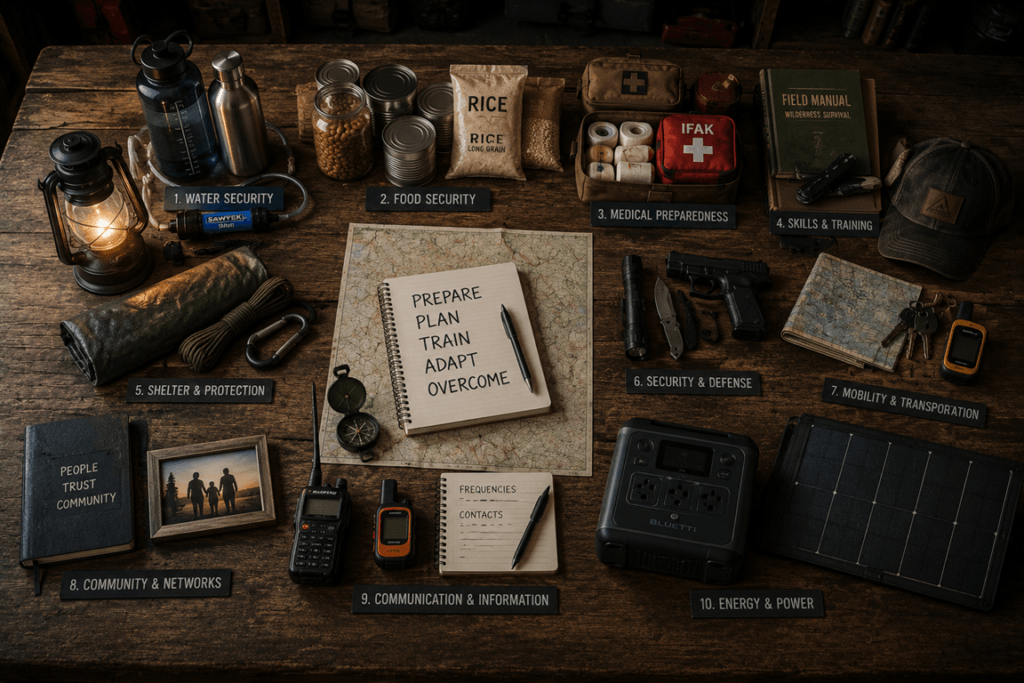
Preparedness can feel overwhelming if you don’t know where to begin. That’s why we’ve built the 10 Pillars of Preparedness—a clear, structured framework that turns uncertainty into a plan. Each pillar represents a core area of resilience, from water and food to defense and community. Think of this as your orientation: a map to the skills, gear, and mindset that build self-reliance.
This series is a living project…rolling out week by week over the next few years. Each pillar will grow into its own library of practical posts, so smash that Subscribe button, and check back often as the framework expands!
What are the 10 Pillars of Preparedness?
- WATER SECURITY – Ensuring reliable access to clean water through storage, purification, and sustainable sourcing when normal systems fail.
- FOOD SECURITY – Building a resilient food system through long-term storage, production, preservation, and disciplined rotation.
- MEDICAL PREPAREDNESS – Developing the capability to manage injuries and illness through training, supplies, and preventive health practices.
- SKILLS & TRAINING – Building hands-on capability and adaptability through practical skills, repetition, and real-world training.
- SHELTER & PROTECTION – Maintaining a secure, durable living environment that protects against threats and supports long-term habitability.
- SECURITY & DEFENSE – Protecting people, resources, and property through layered security planning, awareness, and responsible defense capability.
- MOBILITY & TRANSPORTATION – Maintaining the ability to move, evacuate, and adapt through vehicles, route planning, and navigation awareness.
- COMMUNITY & NETWORKS – Strengthening resilience through trusted relationships, mutual support, and coordinated resource-sharing.
- COMMUNICATION & INFORMATION – Staying informed and connected through reliable communication systems and situational awareness when infrastructure fails.
- ENERGY & POWER – Sustaining critical systems through backup power, energy storage, and disciplined use when the grid is unavailable.
Four Ways to Explore the Framework
Start with the Preparedness Readiness Assessment
Not sure where to begin? Take the assessment to identify your strongest and weakest preparedness pillars, then use your results to choose where to focus first.

Explore by Pillar:
Explore by Learning Tier:
→ Tier 1 – Foundations – Establish the core concepts, priorities, and principles behind each pillar, with these 10 posts.
→ Tier 2 – Core Library – Expand upon each pillar’s foundation with practical skills, planning, equipment, and implementation guidance, with these posts.
→ Tier 3 – Advanced (in development, coming soon) – Deep-dives, advanced applications, and integrated preparedness concepts.
Browse The Entire Framework → 10 Pillars of Preparedness
Preparedness is not about fear—it’s about capability. By strengthening each pillar, you build resilience for yourself, your family, and your community. Start with the foundations, build practical capability, and continue adding layers over time. Preparedness is built one step at a time.